



You Didn’t Come Close – You Experienced a Designed Moment: Why Perception Is Becoming iGaming’s New Regulatory Focus

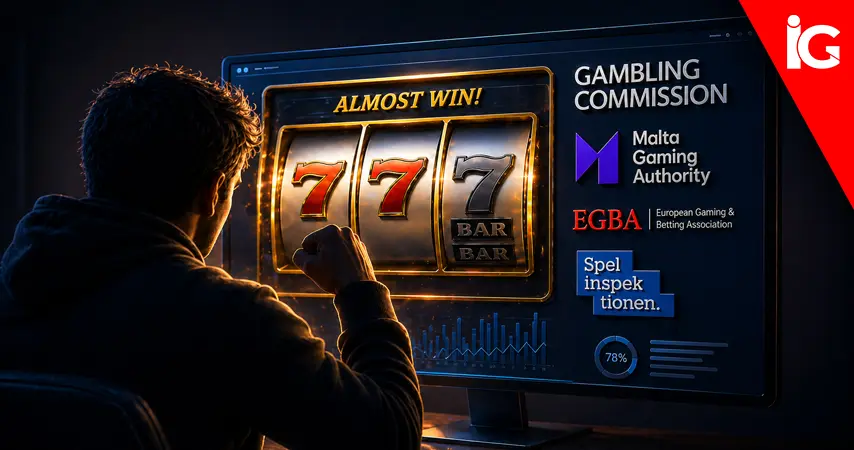
The perception of being “one spin away” from a win is not accidental. It sits at the intersection of neuroscience, UX design, and regulated game mathematics – and is rapidly emerging as a regulatory focus point in 2026.
For years, compliance in iGaming has been anchored in mathematical fairness: certified Random Number Generators (RNGs), transparent Return to Player (RTP) rates, and auditable game logic. That foundation remains intact. However, a parallel layer – how outcomes are experienced by players – is now moving into regulatory view.

What Is a Near-Miss in iGaming?
Behavioral research has consistently shown that near-miss outcomes activate brain regions linked to anticipation and motivation. While these outcomes have no impact on future probabilities, they can significantly influence player behavior – extending session duration, increasing engagement, and reinforcing continued play.
This is not a flaw in the system. It is a feature of how game experiences are designed.
Near-miss outcomes are engineered experiences, not indicators of proximity to a win. The distinction is critical: players may feel closer to success, but every spin remains statistically independent.
Probability vs Player Experience in Casino Games
In regulated environments, outcomes are determined at the moment a spin begins through certified RNG systems. This ensures fairness, randomness, and compliance with established standards.
However, the experience layer operates differently.
Animation timing, reel sequencing, sound design, and visual framing all shape how an outcome is perceived. These elements do not alter probability – but they strongly influence emotional response.
This distinction is becoming both a regulatory risk factor and a commercial constraint, particularly for high-engagement game formats built on near-miss frequency.
Why Regulators Are Focusing on Game Design Experience
Historically, regulators such as the UK Gambling Commission and the Malta Gaming Authority have focused on ensuring that games are mathematically fair and transparent.
That scope is expanding.
The European Gaming and Betting Association is advancing responsible design frameworks, while Spelinspektionen is broadening its interpretation of player protection to include experiential factors – not just outcomes.
This signals a structural shift: compliance is no longer limited to what the game does, but increasingly includes how the game feels.
Operator Impact: UX Design Becomes a Compliance Factor
For operators, this evolution introduces a new layer of complexity.
UX is shifting from a retention lever to a regulated design layer – requiring operators to reassess game mechanics, animation logic, and engagement pacing under compliance frameworks.
Game design choices that were historically optimized for engagement – such as near-miss frequency, reel stopping patterns, or celebratory feedback loops – may now face scrutiny if they are deemed to influence player behavior in ways that conflict with responsible gambling objectives.
This creates a direct tension between engagement-driven product strategy and emerging regulatory expectations.
Experiential Accountability: The Next Phase of iGaming Compliance
What is emerging is a broader alignment between regulators, industry bodies, and responsible gambling advocates around a new concept: experiential accountability.
This goes beyond verifying fairness. It asks whether the design of the experience itself should be subject to oversight.
The implications are significant. Certification processes may evolve to include UX audits. Game studios may need to document behavioral design intent. Compliance teams may expand to include behavioral science expertise.

Conclusion: Near-Miss Design Under Regulatory Scrutiny
A near miss does not indicate progress – but it remains one of the most powerful engagement signals in iGaming.
In 2026, competitive advantage will depend not just on odds – but on how defensibly those experiences are designed under regulatory scrutiny.
Source: Malta Gaming Authority , European Gaming and Betting Association , Spelinspektionen