


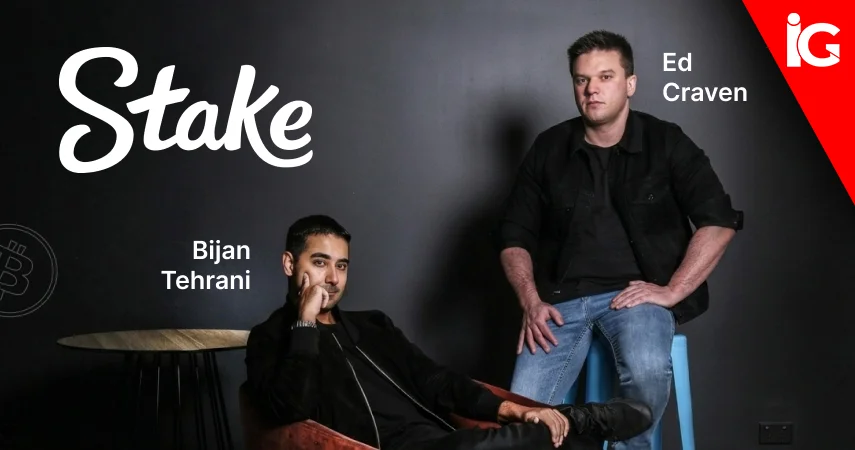
How Ed Craven & Bijan Tehrani Built Stake into a Global Crypto Betting Giant in Today’s Market

In an industry shaped by regulation, licensing frameworks, and market-by-market expansion, the rise of Stake has emerged as one of the more disruptive outliers in modern iGaming.
In many ways, Stake’s ascent highlights a fundamental tension within the industry between regulated market control and borderless digital demand.
Stake is operated by Medium Rare N.V. under a Curaçao-based gambling licence framework under Curaçao eGaming, which allows it to serve users in loosely regulated and unregulated markets.
At the centre of this growth are co-founders Ed Craven and Bijan Tehrani, who launched the platform in 2017 as a crypto-native casino-first product.
While the company does not publish audited financials, industry estimates, including reports cited by Forbes Australia, suggest Stake’s gross gaming revenue may be around $4.7 billion in 2024.
Third-party analytics platforms such as SimilarWeb suggest that Stake may attract over 100 million monthly visits, although figures vary by methodology, placing it among the highest-traffic gambling platforms worldwide, although exact figures vary by source.

Rather than following the traditional path of regulated market entry, the duo have leveraged crypto infrastructure, cross-border accessibility, and digital-first marketing to expand rapidly.
Their success raises a broader industry question: is this a new blueprint for iGaming growth or a strategy shaped by conditions that may not hold long term?
This growth has been widely covered in reporting by Bloomberg and analysis from Financial Times.

From Crypto Startup to Global Brand: Stake’s Evolution Since 2017
Founded in 2017, Stake initially positioned itself as a crypto-native casino-first platform, targeting a niche but rapidly growing segment of digital-first users.
Between 2017 and 2019, the company built its foundation within the cryptocurrency betting ecosystem, focusing on product accessibility and reduced payment friction compared to traditional banking systems.
The next phase of growth accelerated between 2020 and 2022, driven by expansion into streaming platforms, influencer partnerships, and digital communities, alongside major sponsorship activity and high-profile collaborations including partnerships with figures such as Drake. This expansion into partnerships also extends into sports ecosystems, including its collaboration with the X Games, where betting integrations are introduced into live event coverage and digital experiences.
Multiple industry reports describe a partnership widely reported to be valued at up to $100 million annually, although exact terms have not been publicly disclosed, structured largely as promotional and platform-based credits rather than a traditional cash-only endorsement.
During this period, Stake expanded beyond casino into sportsbook offerings, creating a hybrid model designed to increase engagement and session duration. This phase also coincided with rapid user growth as crypto adoption increased globally and streaming-led acquisition channels expanded.
From 2023 onwards, the company entered a new phase characterised by broader international exposure and increasing regulatory scrutiny, particularly as its presence expanded across emerging and loosely regulated markets in regions such as Asia, Latin America, and parts of Europe.
A Founder-Led Model Built for Speed, Not Regulation
While both founders have played critical roles, the company’s strategic direction reflects a shared philosophy prioritising speed, accessibility, and scale over conventional regulatory expansion.
While Ed Craven has emerged as the more visible face of the business, both founders have maintained a relatively low-profile presence despite the platform’s scale.
Under their leadership, Stake was designed as a cross-border platform from the outset targeting users across multiple jurisdictions simultaneously rather than building market-specific operations.
This contrasts with traditional operators, which typically rely on securing local licences before entering new markets.
Crypto at the Core: Removing Friction, Expanding Reach
A defining element of Craven and Tehrani’s strategy has been the integration of cryptocurrency into the core of the platform.
Rather than treating crypto as an optional payment method, Stake built its infrastructure around it enabling faster transactions, reduced reliance on traditional banking systems, and access to users in markets where fiat payment channels are restricted.
For users, this can translate into faster onboarding and fewer payment-related barriers, factors that may contribute to higher engagement and retention. This focus on speed and continuous engagement is also reflected in product innovation, such as Stake’s rollout of simulation-based betting formats such as Simulate in LATAM, designed to deliver instant outcomes and increase session frequency.
However, reliance on crypto also introduces volatility and regulatory uncertainty, particularly as governments increase oversight of digital asset transactions.
Against the System: How Stake Breaks from Regulated Expansion Models
The founders’ approach differs from that of established industry leaders such as Flutter Entertainment and Entain.
While these companies focus on regulated market expansion, compliance-led growth, and jurisdiction-specific licensing, Stake has leveraged a Curaçao-based licence and crypto infrastructure to reach users across multiple regions.
This does not mean the platform is unregulated; rather, it operates under a lighter-touch Curaçao-centric framework and is not locally licensed in many tightly regulated markets.
Stake’s growth also sits within an increasingly competitive crypto-native betting segment, alongside platforms such as Roobet and Rollbit.
This reflects a broader shift towards digitally native betting ecosystems that operate alongside, rather than fully within, traditional regulatory structures.
Attention Over Infrastructure: Winning the Digital-First Player
Another key pillar of Stake’s growth has been its marketing strategy.
The company has focused heavily on influencer partnerships, streaming platforms, and high-visibility sponsorships.
This approach has helped build strong brand recognition among digitally native audiences.
In this environment, attention and community engagement can be as important as product differentiation.
High Growth, High Exposure: The Regulatory Trade-Off
The scale of Stake’s growth has positioned its founders among the most closely watched figures in iGaming.
However, that growth is closely tied to the regulatory environments in which the company operates.
In tightly regulated markets such as the UK overseen by bodies like the UK Gambling Commission and the US, Stake’s core crypto platform is either restricted or not locally licensed.
Unlike fully licensed operators, which operate under strict KYC, AML, and responsible gambling frameworks, some cross-border, crypto-based platforms, including Stake, may offer greater operational flexibility but also face increasing scrutiny.
In addition, regulated operators are subject to stricter responsible gambling and player protection standards, an area where expectations continue to rise globally.
Any tightening of enforcement around crypto-linked betting could impact access, payments, and user acquisition at scale.
This approach also introduces compliance complexities, particularly around anti-money laundering (AML) and know-your-customer (KYC) requirements as global oversight of crypto transactions increases.
What Operators Can (and Can’t) Take from the Stake Playbook
For licensed operators, Stake’s approach is not directly replicable.
Regulatory obligations, compliance requirements, and local licensing frameworks impose structural limits.
However, certain elements of its strategy offer insight:
Faster and more flexible payment systems can improve user experience
Speed of execution can influence competitive positioning
Community-driven marketing can support acquisition and retention
While the full model cannot be adopted within regulated environments, aspects of its operating approach highlight evolving expectations within the industry.

The Real Question: Can This Model Survive What Comes Next?
As regulatory oversight continues to evolve globally, attention is shifting from how Stake achieved rapid growth to how sustainable that model may be under tighter controls.
As regulators increase focus on crypto transactions, licensing enforcement, and consumer protection, the long-term viability of cross-border, crypto-led platforms will likely depend on their ability to adapt to stricter compliance standards.
The outcome may not only shape the future of Stake, but also influence how the broader industry balances innovation with regulation.
For Ed Craven and Bijan Tehrani, the next phase is not just about scale but sustainability.
Is this approach redefining iGaming growth or operating within a model that will need to evolve as regulation catches up?