



£31.4M Revenue. £15M EBITDA. 40+ Partners. One Leader – Gaming Realms CEO Mark Segal, And The Numbers Say It All
Gaming Realms reported FY2025 revenue of £31.4m (+10%), with adjusted EBITDA rising 15% to £15.0m, lifting margin to 48% as its licensing-led model continues to scale with limited incremental cost.
The results reinforce the supplier’s positioning as a high-margin content licensor, with growth driven primarily by Slingo distribution rather than capital-intensive game production.
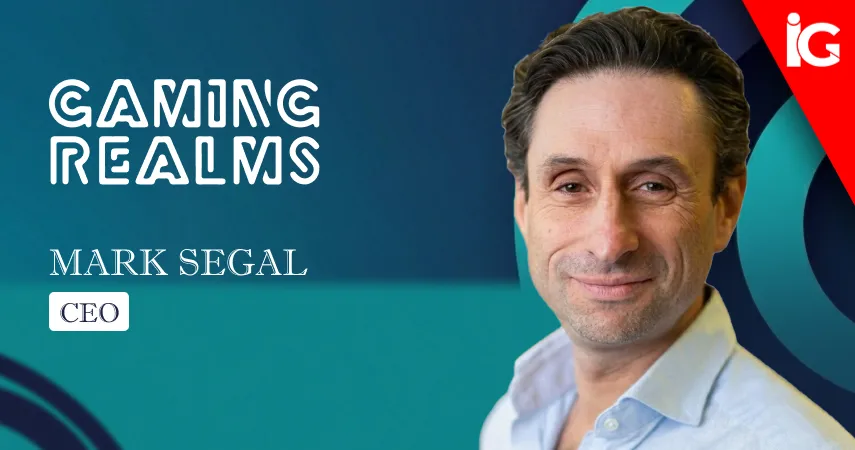
Mark Segal, CEO, said: “Gaming Realms reported a strong year, with revenue up 10% and EBITDA rising 15%, driven by its licensing strategy and Slingo games. In 2025, it expanded into new markets, added 40 partners, and invested in game development, including launching Lucky Lunar Studio. The company has started 2026 positively with further global expansion and expects continued growth.”
Margin expansion highlights scalability of licensing strategy
Licensing revenue increased 13% to £27.6m and remains the core earnings driver, accounting for the majority of group profitability. The segment delivered £16.6m in adjusted EBITDA, underlining the operating leverage of distributing proprietary content across an expanding operator network.
By contrast, social publishing remains marginal, generating £1.2m EBITDA with no growth year-on-year.
The group ended the year with £17.8m in cash and no debt, enabling continued shareholder returns, including a £6.0m buyback (now extended by a further £5.0m). However, the capital allocation strategy prioritises returns over M&A or aggressive content investment, which limits long-term competitive positioning.
North America concentration remains a key dynamic
North America accounted for 63% of licensing revenue, reflecting continued expansion across U.S. regulated states and partnerships with operators including Hard Rock and Hollywood Casino.
While this underpins near-term growth, it also increases exposure to regulatory pacing at the state level, operator concentration risk, and competitive pressure from established U.S. content suppliers.
Expansion into Brazil and Colombia, alongside early-stage African market entries, signals diversification but remains commercially immature relative to the U.S.
Distribution scale, not content volume, driving growth
Gaming Realms added 40 operator partners in 2025 and increased unique players in its licensing business by 22%, confirming distribution-not content volume-is the primary growth lever.
The company launched 12 new Slingo titles and eight bespoke variants, expanded third-party content to 23 games (from 14), and introduced a second internal studio (Lucky Lunar Studio).
The addition of third-party content and a second studio marks a shift toward a hybrid model combining proprietary IP with aggregation. This will accelerate revenue growth but risks diluting differentiation without sustained brand performance.
Regulatory adaptation and UK recovery
The rollout of a new Slingo in-game tool aligned with UK regulatory changes enabled revenue recovery in the market by year-end, highlighting the supplier’s ability to adapt mechanics to compliance-driven design constraints – a capability further reflected in its expansion into tightly controlled jurisdictions, as seen in Gaming Realms Enters Switzerland with Swiss Casinos.
This capability is increasingly critical as regulated markets tighten requirements around gameplay, staking, and session design.
2026 start driven by emerging market expansion
Trading in early 2026 shows licensing revenue up 8% year-on-year (10% constant currency), with launches in Peru, Nigeria, Ghana and Kenya – alongside strategic market entries such as Gaming Realms Enters South Africa via Hollywoodbets with Slingo Launch, reinforcing its early positioning in regulated African markets.
A conditional licence in Alberta and progress toward Maine entry indicate continued focus on regulated market access as the primary expansion strategy.
However, these newer markets are unlikely to materially impact revenue in the near term compared to North America.
Outlook: scalable model intact, but competitive pressures rising
Gaming Realms enters 2026 with a high-margin licensing model, expanding global distribution, and increasing hybridisation of content supply.
The next phase hinges on three factors: whether Slingo can sustain differentiation as slot supply intensifies, how effectively third-party aggregation scales without margin dilution, and whether geographic diversification can meaningfully reduce U.S. concentration.
The current trajectory supports continued growth, but sustaining a near-50% EBITDA margin will depend on maintaining content relevance and negotiating power with operators.
Source: Gaming Realms