



Kambi Reports Q1 2026 Results as Profitability Improves Under CEO Werner Becher

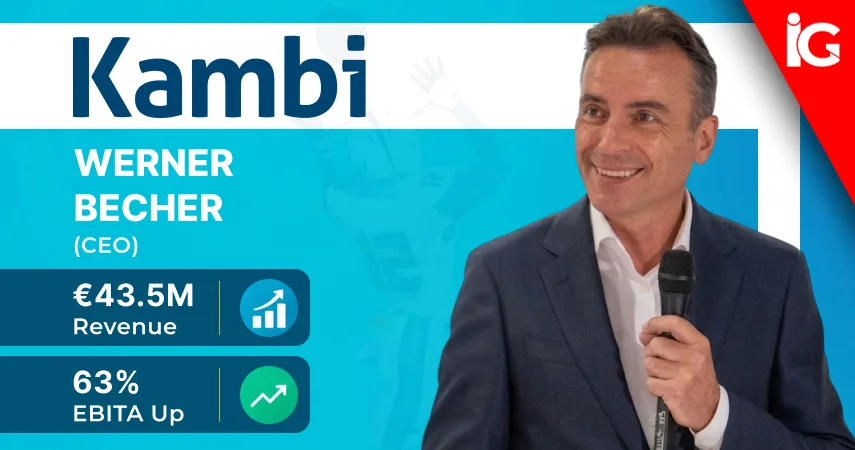
Kambi started 2026 with a steady first quarter, reporting revenue of €43.5 million, up 4.9 percent year-on-year. Growth was relatively modest, but profitability improved noticeably, supported by better cost control and operating leverage.
Adjusted EBITA increased 63.5 percent to €5.7 million, while operating profit came in at €4.2 million, with margins rising to 9.7 percent. Earnings per share reached €0.086, reflecting stronger overall efficiency.
CEO Werner Becher said the business is moving in the right direction, with both commercial activity and internal efficiencies contributing to the start of the year.

Canada Lottery Deal Positions Kambi at the Center of Regulated Growth
One of the main developments this quarter was Kambi’s agreement with Atlantic Lottery Corporation and British Columbia Lottery Corporation to deliver a multi-province sportsbook solution across Canada.
Together with its existing partnership with Ontario Lottery and Gaming Corporation, Kambi is set to power sportsbooks in eight out of ten provinces. This strengthens its position within lottery-led, regulated markets.
Kambi also entered the French market through a long-term agreement with Pari Mutuel Urbain (PMU), marking its entry into one of Europe’s larger regulated betting markets.

Odds Feed+ Signals Shift Away from Pure Turnkey Dependency
Alongside its main sportsbook product, Kambi continued to expand its Odds Feed+ offering through agreements with operators such as ComeOn Group, Hard Rock Bet, Coolbet and LeoVegas.
This points to a gradual shift in the market, where some operators are choosing specific services instead of full turnkey solutions, allowing more control over their own product setup.
AI Trading and Cost Cuts Explain the Margin Jump — Not Revenue Growth
Efficiency played a major role in the quarter. More than 60 percent of bets were handled through AI-driven trading, reducing the need for manual processes and helping scalability.
Operating expenses were down 2.1 percent, while total expenses remained slightly lower year-on-year, showing the impact of ongoing cost measures.
These factors helped lift margins, even though revenue growth itself remained relatively limited.
New Launches Expand Footprint — But Not Without Trade-Offs
Kambi rolled out several partner launches during the quarter, including Ontario Lottery and Gaming Corporation, LCKY Group in Sweden, and Pickwin in Mexico.
The company also continued to expand across North America and other regulated markets, adding both online and retail sportsbook operations.
Turnover Drops and Tax Pressure Reveal Underlying Weak Spots
Despite stronger profitability, some underlying pressures remain. Operator turnover declined by 3 percent year-on-year, affected by market exits, currency movements, and higher operator margins.
Regulation continues to play a role. A new tax in Colombia is expected to reduce full-year revenue by around €4 million, while partner changes, including FDJ UNITED exiting certain markets, are also impacting performance.
Most of Kambi’s business still comes from regulated markets, which accounted for 98.2 percent of turnover, with the Americas contributing 59.4 percent.
Guidance Holds — But Growth Is Increasingly Margin-Led
Kambi maintained its full-year adjusted EBITA guidance of €20–25 million, supported by efficiency gains, new partnerships, and upcoming events such as the FIFA World Cup.
At the same time, growth is becoming more dependent on margin improvements rather than strong revenue expansion.
For Operators: More Control, But Deeper Supplier Dependence
There is a gradual shift in how Kambi is operating. Alongside turnkey solutions, products like Odds Feed+ are becoming more important.
For operators, this means more flexibility in choosing services, but also greater reliance on suppliers for core functions like pricing and trading.
Lottery partnerships also highlight how regulated markets are becoming central to long-term growth.

Margin Strength Looks Structural — But Growth Remains Controlled
The gap between revenue growth and profit growth suggests a more disciplined approach, with efficiency and automation playing a bigger role.Kambi continues to invest in trading technology, product development, and regulated market partnerships, aiming to maintain steady progress rather than rapid expansion.
Source : Kambi