



Why Most iGaming Startups Fail: Understanding the Real Cost of Building an Online Casino

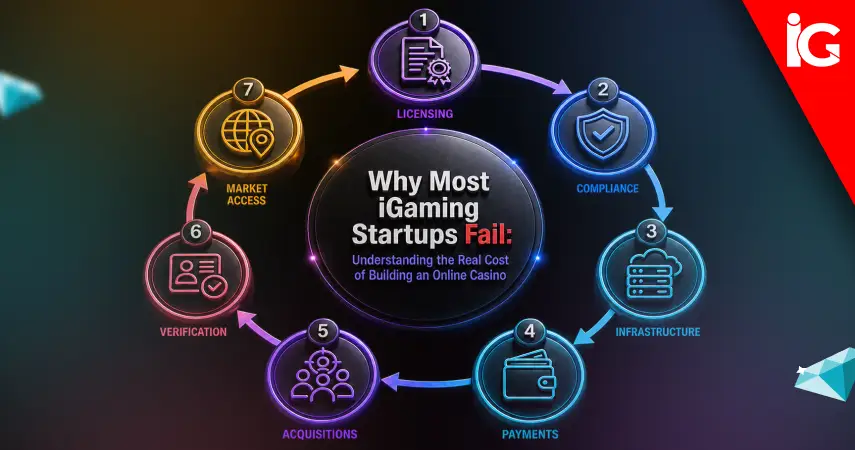
The global iGaming industry has expanded rapidly as more jurisdictions introduce regulated online gambling frameworks and operators continue to invest in digital platforms. While launching an online casino may appear straightforward from a player perspective, the operational reality is far more complex.
Operators must invest in licensing, technology infrastructure, game content, compliance systems, payment integrations and marketing before entering the market. Depending on the jurisdiction and business model, initial setup costs for launching an online casino can range from $50,000–$300,000 for lean, white-label operations to $1 million or more for fully custom, multi-market platforms in highly regulated jurisdictions.
Understanding this process from launch to scale provides a clearer view of how online gambling businesses are built, operated and expanded.

Licensing and Application Process
The first step in launching an online casino is securing a gambling licence from a recognised regulator.
Regulators such as the Malta Gaming Authority and the Gibraltar Gambling Commission are widely used in regulated markets, while lower-cost options include:
- Curaçao Gaming Control Board
- Kahnawake Gaming Commission
Requirements
Operators must typically provide company incorporation documents, a business plan, proof of funds, ownership details and platform-related technical documentation.

Process
The licensing process typically involves preparing documentation, submitting the application, undergoing regulatory due diligence, completing compliance checks and receiving final approval from the regulator.
Timeline
- 4–6 weeks (offshore jurisdictions)
- 3–6 months (regulated markets)
Typical costs include:
- €5,000 application fee
- Annual licence fees starting around €25,000 for certain licence types, with higher fees applying in some jurisdictions
- $20,000–$80,000 compliance and legal costs annually, depending on scale and regulatory requirements
Regulatory Compliance and Guidelines
Operators must comply with strict regulatory frameworks designed to protect players and ensure fair operations.
Responsible Gambling
Operators are required to implement responsible gambling tools such as deposit limits, self-exclusion options and session reminders.
AML and Financial Monitoring
This includes monitoring transactions, reporting suspicious activity and maintaining detailed financial records in line with regulatory requirements.
Identity Verification
Providers such as:
- Sumsub
- Onfido
are used to verify users and ensure compliance.
Game Testing
Independent labs such as:
- eCOGRA
ensure that games meet fairness and compliance standards.
Platform Development: Custom vs White-Label
Operators must decide how to build their platform.
Custom Platforms
Custom development offers full control over infrastructure but requires significant investment, typically ranging from $500,000 to more than $2 million, depending on features, integrations and market scope. Development timelines typically range from 12 to 24 months, with some complex multi-market platforms extending beyond 24 months.
White-Label Solutions
Providers include:
- SoftSwiss
- EveryMatrix
These solutions offer faster market entry with lower upfront costs:
- $15,000–$150,000 setup cost
- 10%–20% revenue share of GGR under standard models
Game Content and Aggregation
Operators integrate casino games through studios and aggregation platforms.
Game providers include:
- Yggdrasil Gaming
- Thunderkick
Aggregation platforms such as:
- Relax Gaming
- Pariplay
enable integration of hundreds to thousands of games through a single API.
Game-provider revenue shares commonly range from 10% to 25% of GGR, with some premium or niche studios charging higher or performance-based percentages.
Sportsbook Integration
Many operators expand beyond casino into sports betting.
Providers include:
- Kambi Group
Sportsbook technology partners typically charge 5% to 15% of gross revenue under standard models, although some agreements may use hybrid or profit-share structures.
Payments, Banking and Merchant Accounts
Operators must establish reliable payment and banking infrastructure.
Payment providers include:
- Skrill
- Paysafe
Modern solutions include:
- Trustly
Operators must also secure gambling-friendly merchant accounts, which is often one of the more complex steps in the setup process.
Transaction fees typically range between 1%–3% for crypto payments and 2%–5% for traditional payment methods.
Payment Risk and Fraud Management
Online gambling operates in a high-risk payment environment where operators must manage chargebacks, fraudulent transactions and payment failures. Chargeback rates in high-risk sectors can reach 0.9% to 1.5%, making fraud prevention systems critical for protecting revenue.
Geo-Compliance and Market Access
Operators must ensure their platforms are accessible only in licensed jurisdictions. Geo-location systems are used to restrict access to prohibited regions, ensuring compliance with local laws and avoiding regulatory penalties.
Infrastructure and Operations
Online casinos rely on scalable infrastructure and operational teams.
Cloud providers include:
- Amazon Web Services
Typical infrastructure costs range between $5,000 and $20,000 per month, depending on traffic and platform scale.
Operational costs include staffing across compliance, fraud prevention and customer support functions, with key roles costing between $80,000 and $120,000 annually, alongside $10,000–$50,000 in legal and insurance costs.
Marketing, Bonuses and Affiliates
Marketing is one of the largest expenses in iGaming.
Operators such as:
- Rush Street Interactive
invest heavily in acquisition strategies.
Customer acquisition costs in competitive iGaming markets can range from $150 to $800 per player, with $300–$650 often observed among Tier-1 operators. Promotional bonuses and affiliate partnerships can account for 20% to 50% of player lifetime value.
Player Retention and CRM
Long-term profitability depends on retaining players and increasing lifetime value. CRM-driven segmentation and lifecycle marketing can improve retention rates by 10%–30% or more, depending on data quality, segmentation sophistication and campaign execution.
Risk Management and Player Monitoring
Operators must monitor player behaviour to identify high-risk activity, prevent bonus abuse and manage betting patterns effectively. In sportsbook operations, risk exposure must be carefully balanced to maintain margins.
Gambling Taxation and Duties
Operators must pay gambling taxes in regulated markets on gross gaming revenue (GGR).
Examples include:
- United Kingdom – ~21% Remote Gaming Duty
In some markets, effective tax and regulatory burdens can exceed 30%–50% of GGR, depending on local levies and compliance requirements.
Multi-Market Expansion Strategy
Many operators begin in one jurisdiction before expanding into additional markets. Expansion requires securing new licences, adapting to local regulations and integrating region-specific payment systems, often increasing incremental operational costs by 20%–40% per new market.
Mobile Optimisation and User Experience
Mobile devices frequently account for 60%–80% of iGaming traffic, with some markets exceeding the higher end of this range. Operators must ensure mobile-friendly platforms, fast performance and seamless user experiences to support retention and growth.

Conclusion
Launching an online casino involves building a multi-layered ecosystem that includes licensing, compliance, technology infrastructure, payment systems and marketing strategies.
While lean entry models can begin at around $50,000–$300,000, competitive operators in regulated markets often require $1 million or more, with ongoing operational and marketing costs scaling alongside growth.
As the global iGaming industry evolves, success depends on balancing acquisition costs, regulatory compliance and long-term player value to achieve sustainable profitability.
Source : Malta Gaming Authority, UK Gambling Commission, Curaçao Gaming Control Board, Statista, Grand View Research, International Data Corporation, SoftSwiss, EveryMatrix, Paysafe,