



$4.5B Revenue, Digital Up 43%: Under Bill Hornbuckle, MGM Resorts International Is Building Gaming’s Most Balanced Growth Engine

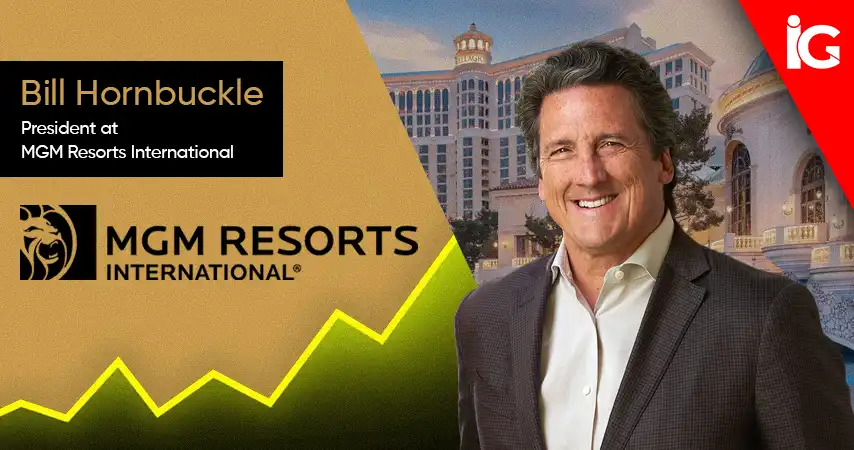
MGM Resorts International delivered record first-quarter consolidated revenue of $4.45 billion, up 4% year-on-year, but the stronger top line masked a more important operating reality: profitability across its legacy casino estate is becoming harder to defend, while its digital business is starting to emerge as a meaningful earnings contributor.
Net income attributable to MGM declined to $125.1 million from $148.6 million a year earlier, while adjusted EBITDA fell 9% to $580.2 million, down from $637.1 million. Diluted EPS also softened to $0.48, compared with $0.51 in Q1 2025.
The operating divergence is clear. Revenue continues to grow, but earnings quality is under pressure – and MGM’s expanding digital footprint is increasingly helping offset margin compression in mature land-based operations.

BetMGM reaches a profitability inflection point
BetMGM was one of the most commercially significant developments in the quarter.
MGM’s share of operating income from the joint venture swung to a $7.4 million profit, compared with a $15.2 million loss in the same period last year. That marks a clear profitability inflection point and signals that BetMGM is beginning to shift from capital consumer to earnings contributor.
For operators, this reinforces a broader market trend: major US online betting businesses are moving beyond aggressive acquisition-led expansion and entering a more disciplined monetisation phase.

Customer acquisition costs remain elevated across the industry, but BetMGM’s improving economics suggest stronger player value extraction, better operational efficiency and a more sustainable long-term earnings model.
LeoVegas strengthens MGM’s owned digital growth strategy
LeoVegas and MGM’s owned digital assets also posted strong momentum, with revenue rising 43% to $182.7 million, while EBITDAR losses improved to $25.6 million, compared with $34.4 million a year earlier.
The strategic significance is not simply rapid revenue growth – it is that losses are narrowing while scale increases, indicating improving monetisation, stronger cost efficiency and early operating leverage across MGM’s owned digital infrastructure.
This gives MGM two distinct digital earnings channels:
- BetMGM in North America
- LeoVegas-led owned digital operations across Europe, Brazil and broader international markets
That level of digital diversification remains uncommon among major US casino operators and materially strengthens MGM’s long-term online positioning.
Las Vegas remains stable, but margins continue to tighten
MGM’s Las Vegas Strip operations delivered broadly stable revenue at $2.18 billion, marking the first year-on-year quarterly revenue increase since Q3 2024. Demand remains resilient, but profitability trends were notably softer.
Adjusted EBITDAR fell 8%, casino revenue declined 5%, RevPAR slipped 2%, and occupancy declined to 92% from 94%.
The takeaway is straightforward: volumes are holding, but margin protection is becoming more difficult.
Labour inflation, heavier promotional activity, cost normalisation and softer premium spend mix are all likely contributing factors. For Strip competitors, the message is clear – Las Vegas demand remains healthy, but operating leverage is weakening.
Macau growth remains solid, but fee structures weigh on profitability
MGM China Holdings Limited continued to post healthy operating momentum, with revenue up 9%, casino revenue also rising 9%, and main floor table win increasing 18%.
However, EBITDAR declined 4%, largely because of a new branding agreement that increased intercompany licensing fees from $18 million to $41 million.
Operationally, Macau remains a growth market for MGM. Financially, however, reported margins are now carrying a structurally higher corporate fee burden, creating dilution at segment level despite strong underlying demand.
Capital allocation is becoming increasingly digital-led
MGM also completed the $546 million sale of Northfield Park operations, further strengthening liquidity and supporting continued capital returns. Cash rose to $2.29 billion, while management repurchased $90 million of shares during the quarter, with $1.5 billion still authorized for buybacks.
More importantly, portfolio recycling continues to sharpen MGM’s strategic mix.
Capital is increasingly being directed toward:
- digital expansion
- premium destination resorts
- Japan integrated resort development
- high-return strategic growth projects
The company’s long-term direction is becoming clearer: lower regional asset intensity, greater digital scale and deeper exposure to premium destination-led earnings.

Bottom line
Strategically, this was a stronger quarter than the headline earnings figures suggest.
The core story is not revenue growth. MGM’s digital operating model is beginning to demonstrate scalable economic viability just as its legacy casino portfolio transitions into a slower-growth, lower-margin cash generation business.
That shift could define MGM’s competitive position over the next several years.
Source: MGM Resorts International