



€285.3M Revenue, +11% Active Customers: Under Pontus Lindwall, Betsson AB Turns Q1 2026 into a Strategic Growth Signal

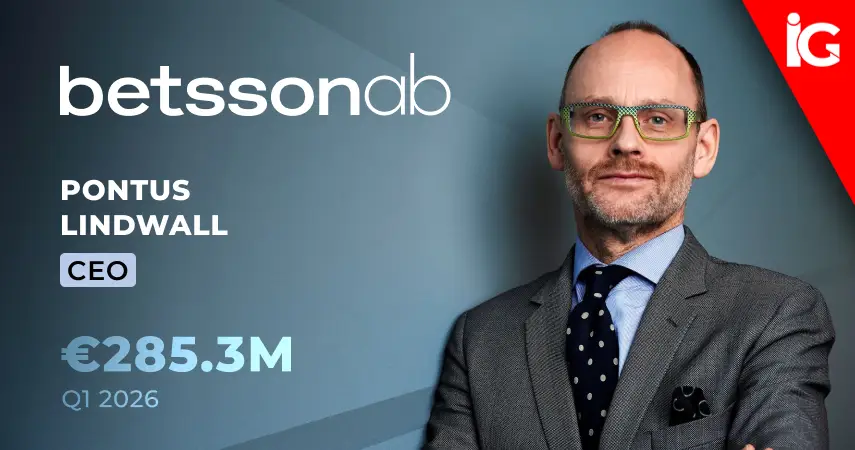
Betsson AB entered 2026 with continued customer growth and strong momentum across regulated B2C markets, but its first-quarter results underline a tougher commercial reality: expansion in regulated jurisdictions is proving materially less profitable, while weakness in B2B continues to weigh on earnings.
Group revenue fell 3% year-on-year to EUR 285.3 million, although organic growth remained positive at 4.3%. The sharper concern was profitability. EBITDA declined 36% to EUR 50 million, while EBIT fell 47% to EUR 34 million, reducing EBIT margin to 11.9%, down from 21.8% a year earlier.

Latin America Becomes a Core Earnings Pillar
B2C revenue rose 15%, driven primarily by Latin America, where revenue increased 25% and now accounts for roughly one-third of group revenue.
Peru remained a standout market, supported by strong casino and sportsbook performance, while Colombia also delivered growth despite regulatory disruption. Western Europe added another layer of momentum, with Italy posting record quarterly revenue and continued market share gains across both verticals.
The regional earnings mix is now becoming clearer:
Latin America is no longer simply a growth market – it is now a core earnings pillar for Betsson.
Active customers rose 11% to 1.52 million, highlighting continued acquisition and retention strength despite softer deposits.
Regulation Is Driving Margin Dilution
The earnings contraction was primarily cost-led.
- higher gaming taxes
- increased payment processing costs
- higher regulatory licence expenses
- heavier compliance overhead
- quarterly investment losses of roughly EUR 10 – 15 million in newer B2C markets
Gross margin fell sharply from 64.0% to 57.6%, illustrating how quickly regulated-market expansion can dilute earnings quality – even when customer KPIs remain healthy.
The strategic trade-off is becoming more visible: more regulated revenue, but lower margin conversion.
Locally regulated markets accounted for 73% of revenue, up from 59% a year ago – a record high.
B2B Remains Betsson’s Clearest Earnings Weakness
The weakest segment in the quarter was Betsson’s B2B business.
License revenue fell to EUR 51.2 million from EUR 90.2 million, largely due to lower activity from one major customer. While management says activity has stabilised since December, the scale of the decline highlights concentration risk within the supplier business.
Until Betsson broadens its B2B revenue base beyond key customer concentration, earnings volatility in that segment is likely to remain elevated.
Rhino Acquisition Adds Strategic Scale
Betsson’s agreement to acquire Rhino Entertainment Group assets adds meaningful strategic optionality.
- B2C operations
- Canadian licence access
- B2B technology assets
- EUR 13.7 million pro forma EBITDA (2025)
At roughly 4.7x EBITDA, the valuation appears financially disciplined.
More importantly, the deal strengthens Betsson’s position across both operating segments by expanding market access, increasing platform scale, and improving long-term operating leverage.
For Betsson, Rhino is more than expansion – it is a strategic infrastructure acquisition.

Outlook
Trading into Q2 has started positively, with average daily revenue up 3.7%, although sportsbook hold has been above historical averages, making early-quarter comparisons less reliable.
The broader investment case is increasingly defined by one question:
Can Betsson convert strong regulated-market growth into higher-quality earnings while rebuilding B2B contribution?
Q1 suggests customer momentum remains strong. Profit conversion is where execution now needs to improve.
Source: Betsson AB