



Prediction Markets Just Hit the Fairway – LIV Golf x Novig Is Changing the Game Forever

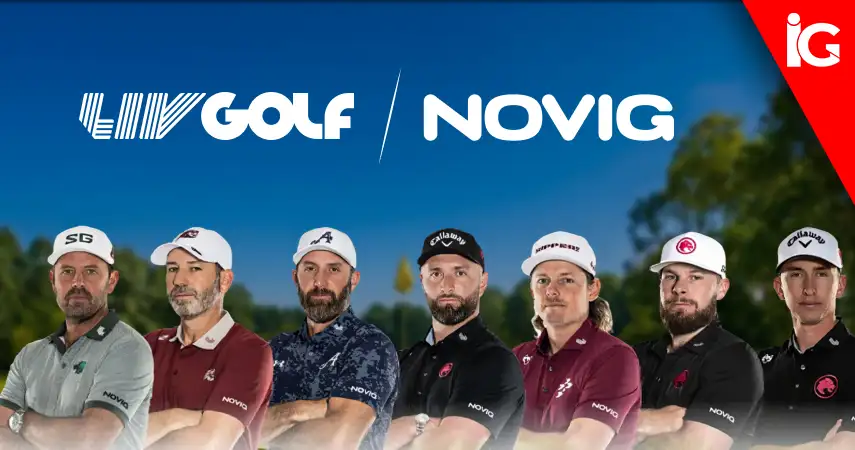
LIV Golf has teamed up with Novig to roll out a prediction market activation during the opening major championship window of the 2026 golf season. More than a branding exercise, this is effectively a live test of whether peer-to-peer trading models can attract and convert users at scale when placed inside premium golf exposure.
As part of the agreement, Novig branding will appear on the sleeves of seven LIV players competing between April 9-12, including Jon Rahm, Dustin Johnson, Cameron Smith, and Sergio Garcia. The timing is deliberate- this stretch consistently draws one of the largest audiences in golf, giving LIV added reach outside its own event calendar.

Sponsorship as a User Acquisition Engine
This is not a typical sponsorship in the traditional sense. The structure leans much closer to a performance-driven acquisition play.
Novig is expected to launch event-linked prediction markets tied to tournament outcomes, supported by a $500,000 in-app contest aimed at encouraging repeat participation. Alongside that, LIV’s social channels will carry distribution-heavy, short-form content designed to keep the activation visible throughout the event window.
Taken together, the setup points clearly toward a CAC-focused approach. The goal is not just visibility, but conversion- using a high-intent sports audience to see whether prediction markets can onboard users more efficiently than standard sportsbook funnels. The daily participation layer also hints at a longer-term engagement loop, rather than a one-time promotional spike.
Pressure Testing Prediction Markets in a Sportsbook Market
The timing is notable. Prediction markets have been steadily positioning themselves as an alternative to traditional sportsbooks, and this activation puts that proposition in front of a mainstream audience.

Novig’s peer-to-peer structure- without a built-in operator margin- goes directly after some of the core mechanics of sportsbook models, particularly hold, pricing control, and liquidity management.
At the same time, it’s important to note what this is not. The partnership stops short of full betting integration and instead sits as a marketing layer around the event. That restraint likely reflects the still-evolving regulatory landscape in the US, where sports-linked prediction markets remain a grey area.
From an operator perspective, the signals are hard to ignore:
- Exchange-style and peer-to-peer models are gaining visibility
- Pricing transparency is becoming more central to differentiation
- Margins could come under structural pressure if liquidity in these models scales
LIV Golf’s Commercial Strategy Expands Beyond Owned Inventory
For LIV Golf, the move highlights a broader shift in how it is approaching sponsorship value.
By placing partner branding on players during non-LIV events, the organisation is effectively tapping into audience reach it does not directly control through media rights. It’s a way to extend commercial exposure without expanding the event calendar itself.
More importantly, it reframes LIV’s role. Rather than operating purely as a closed competition structure, it is starting to function as a distribution layer for sponsors-something that could appeal strongly to digital-first betting and gaming brands looking for access to premium moments without negotiating full rights deals.

Market Implications
This is less about immediate revenue and more about testing where the market is heading.
Three shifts are converging here:
- Prediction markets moving into mainstream sports marketing environments
- Athlete-led sponsorships becoming more flexible than event-bound inventory
- Betting-adjacent products competing on experience and mechanics, not just odds
If the model delivers on acquisition or engagement, it’s likely we’ll see similar activations expand into other sports and major events- especially in areas where fragmented rights structures create openings for non-traditional entrants.
Source: LIV Golf