


One Strategy. Thirty Years. Forty Jurisdictions. How Sokratis Kokkalis Built Intralot Into a Global Lottery Empire

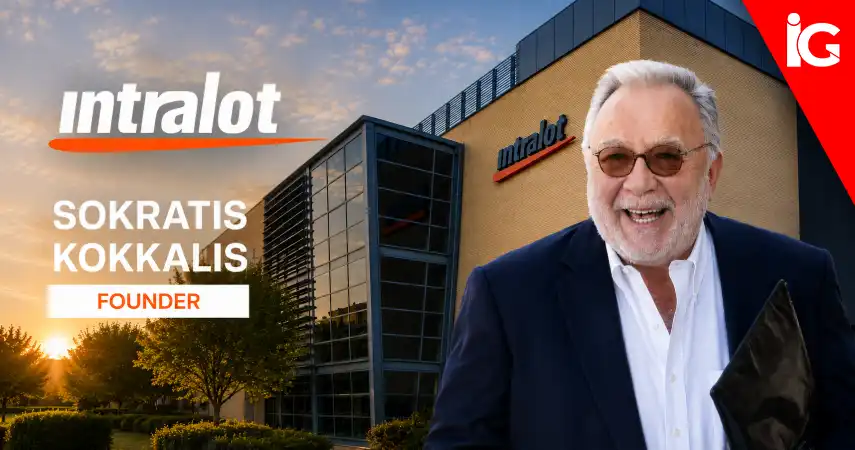
Sokratis Kokkalis founded Intralot in 1992 as a spin-off from Intracom, and the company later became Bally’s Intralot after completing a €2.7 billion transaction in October 2025.
Kokkalis, a Greek businessman born in 1939 with degrees in physics and electronics, founded Intracom in 1977, building it into one of South-Eastern Europe’s largest technology groups. Intralot emerged from that group as a specialist supplier of lottery and gaming infrastructure for state operators. Three decades later, the combined entity ranks among the largest listed companies on the Athens Stock Exchange.
In an industry shaped by consumer brands and casino expansion, Intralot’s trajectory illustrates the long-term dynamics of a regulation-led, government-anchored growth model.

The Founder Who Bet Against the Casino Era
When Kokkalis founded Intralot in 1992, online gambling was not yet a commercial market. The company listed on the Athens Stock Exchange and focused on terminals, transaction systems and lottery infrastructure for public sector operators. That specialist positioning in the regulated B2G segment defined the company’s direction for the following three decades.
One Greek Lottery Contract That Became Dozens of Jurisdictions
Intralot’s early work began with OPAP, the Greek state gaming operator. In 1993, it took over the production and management of OPAP’s scratch card operations through a joint venture. In 1999, its Betting Company S.A. unit assumed responsibility for OPAP’s football betting operations, launching PAME STOIXIMA, which became one of Europe’s most widely used state-backed betting products. By 2004, the company had crossed Greek borders by operating the National Lottery of Malta through its Maltco Lotteries subsidiary, opening a sustained phase of international expansion through Europe, the Americas, Asia and Africa.
The company built long-term contracts with multiple US state lotteries, including New Hampshire, Idaho and Illinois, alongside the British Columbia Lottery Corporation in Canada. Its LotosX Omni platform was rolled out across cloud-based lottery deployments in North America from 2024 onwards.

The expansion was not without setbacks. Intralot lost its Malta concession in 2022 after 18 years of operation, exited the Ohio sports betting kiosk market in July 2025, and paid $6.5 million in restitution to settle a D.C. Lottery procurement case earlier that year.
520 Million Euro and the Year Everything Compounded
Bally’s Intralot reported full-year revenue of €520.6 million for 2025, a 35.5 per cent increase year-on-year, with adjusted EBITDA of €184.6 million at a 35.5 per cent margin. The group closed 2025 holding €246.7 million in cash.
Bally’s International Interactive contributed approximately €167–170 million in revenue and around €67 million in adjusted EBITDA during less than three months of consolidation following the October 2025 closing. B2C iGaming and betting revenue rose to €242.4 million from €92.3 million the prior year, with iGaming and sports betting now accounting for approximately 45 per cent of total revenue.
On a pro forma basis including a full-year contribution from Bally’s International Interactive, the combined business is projected to deliver annual revenue of approximately €1.086 billion.
The group posted a pre-tax loss of €41.0 million for 2025, compared to an €18.0 million profit in FY24, reflecting elevated depreciation, amortisation, transaction fees and finance costs following the merger.
The 2.7 Billion Euro Acquisition That Rewrote Intralot’s Identity
The €2.7 billion Bally’s merger was announced in July 2025 and completed on 10 October 2025. Intralot acquired Bally’s International Interactive for an enterprise value structured as €1.53 billion in cash and approximately €1.136 billion in newly issued Intralot shares. The transaction created Bally’s Intralot, with Bally’s Corporation becoming the majority shareholder at a 58 per cent stake. A parallel share issue was oversubscribed multiple times, underscoring institutional appetite for regulated, scaled gaming infrastructure.
Kokkalis, who returned to an executive leadership role in 2019 to oversee refinancing and strategic repositioning, retained a board position in the rebranded group.
Now Targeting William Hill: The 225 Million Pound Evoke Move
In April 2026, Evoke plc, the London-listed parent of William Hill UK, 888 and Mr Green confirmed active takeover discussions with Bally’s Intralot at 50 pence per share. The proposal values Evoke at roughly £225.3 million, representing approximately a 29 per cent premium to its prior closing price. The structure is an all-share combination with a partial cash alternative.
Evoke carries approximately £1.8 billion in net debt. Bally’s Intralot CEO Robeson Reeves stated the group had identified substantial strategic and operational synergies, citing enhanced scale, expanded geographic footprint and opportunities for cost efficiencies. If completed, the transaction would fold William Hill, 888 and Mr Green into the Bally’s Intralot platform, giving the Athens-listed group a stronger position in UK retail and online betting alongside its global lottery footprint.
Under UK Takeover Panel rules, Bally’s Intralot must announce a firm intention to make an offer or walk away by 5 pm London time on 18 May 2026. The deadline may be extended with Evoke’s consent.
Why Public Markets Are Suddenly Paying for Regulatory Pedigree
Gaming is consolidating around scale, regulation and technology. Platform owners with established regulatory credentials and government-grade compliance infrastructure have attracted institutional interest. The Bally’s Intralot transaction and the subsequent Evoke approach reflect that shift.
Regulatory relationships of the kind Intralot built over three decades are not replicable through acquisition alone; they require sustained contract performance within government procurement frameworks. That has become a differentiated asset as the industry consolidates around scale and licensed footprint.
The Uncomfortable Lesson for Operators and Founders
For operators and founders, the implication is direct. The fastest-growing iGaming companies of the next decade may not only be the ones with the loudest brands. They are also likely to be the ones with the deepest regulatory relationships and the most defensible technology stacks.
Marketing budgets can manufacture awareness in months. Regulatory pedigree typically takes years and cannot be replicated through paid acquisition alone. Intralot’s value did not come solely from product innovation or category disruption. A significant share of it came from being among the small number of suppliers globally that governments rely on to run central lottery systems at the national level, a position built through decades of contract performance, not marketing spend.

Selling the Slowest Corner of Gaming Back to the Loudest
Kokkalis built early inside the slowest, most regulated corner of gaming. The combined entity is now using that foundation to pursue legacy consumer brands at distressed valuations. The 18 May 2026 deadline will indicate whether the next chapter of Bally’s Intralot’s expansion runs through London.
Source : Intralot