


Evolution Pays £4.75m to Close UKGC Review Over Unlicensed Site Exposure

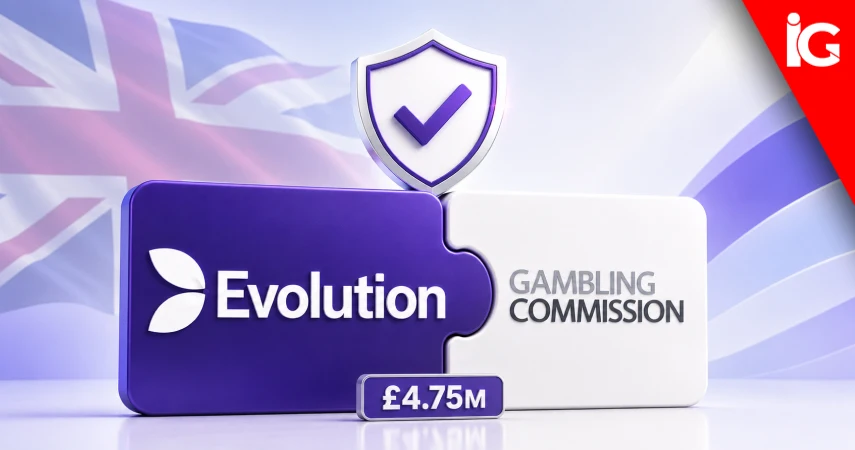
An 18-month licence review has ended with a GBP 4.75 million cheque and a redrawn line of responsibility across the B2B supply chain.
Evolution has agreed a GBP 4.75 million settlement with the UK Gambling Commission, concluding the licence review opened in December 2024. The finding centres on Evolution game content appearing via two operators across six websites that served British consumers without a UK licence, in breach of Evolution’s terms of supply.

The Commission findings
The two operators actively evaded the restrictions Evolution had in place at the time. Across the full 18-month review, the Commission identified no broader pattern of unlicensed access to Evolution content in the UK, which narrows the case considerably. Evolution terminated both commercial relationships immediately upon discovery and cooperated throughout, consistent with its stated approach to regulatory engagement.
The company has since introduced enhanced ring-fencing measures alongside the technical, legal and commercial controls it already runs to identify and prevent unauthorised access to its content. Evolution’s own position is that no system can entirely eliminate attempts by third parties to circumvent controls.
Evolution’s public position
Martin Carlesund, CEO of Evolution, said it is not acceptable that six unlicensed sites offered Evolution content in the regulated UK market, that the company does not want traffic from unlicensed operators, and that it will always move quickly to address any such situation.
The remark matters less as reassurance than as positioning. Evolution is signalling to regulators that it does not treat contractual terms as a defence, and that it accepts an active enforcement duty over its own distribution. That is a meaningful concession from a supplier of its scale, and it will be read as such by every other B2B licence holder in the market.

The regulatory perimeter has moved upstream
The weight of the outcome sits in a single fact. Terms of supply were breached by third parties acting deliberately, Evolution cut them off on discovery, and the settlement still landed.
For a market where content distribution runs through aggregators, white labels, resellers and platform layers, that changes the risk map. Contract language is now table stakes. The test the Commission appears to be applying is not whether unauthorised distribution was prohibited on paper, but whether the supplier could detect it and how fast it could stop it once found.
That reframes compliance from a legal function into an operational one. Detection capability, traffic monitoring, ring-fencing architecture and termination protocols are the things that now carry evidential weight under review. Policy documents do not.

The commercial read for operators, founders and CMOs
Suppliers building or defending UK exposure should treat this as a cost-of-entry recalculation rather than a one-off penalty. The infrastructure required to evidence enforcement is becoming a licence condition in practice, whatever the paperwork says, and it carries a fixed cost that has to sit in the model from day one.
For operators, the read-through is on partner selection. A supplier that cannot demonstrate distribution control is a liability that travels down the chain. For founders raising or selling into the UK, compliance maturity is now a diligence line item with a visible price attached, and this settlement gives that price a number.
Every commercial agreement in the distribution chain is now a regulatory exposure. The industry has just been shown what one costs.
Source: Evolution