


Exclusive Interview: Sotiris Pappas on Operational Strategy, AI and Sustainable Growth at Campeón Gaming

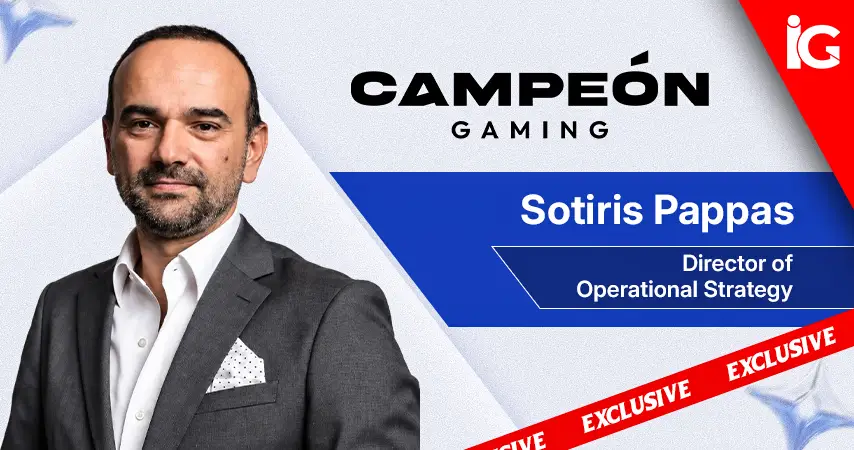
Sustainable growth in iGaming depends on more than strong financial performance. Businesses also need aligned teams, efficient processes, effective technology and the ability to turn strategic plans into measurable results. For Sotiris Pappas, Director of Operational Strategy at Campeón Gaming, connecting these elements is central to building a stronger and more adaptable operation.
In an exclusive interview with iGaming News Today, Pappas reflects on his journey into the iGaming industry and explains how his current role focuses on creating value across technology, people, internal processes and business operations. He discusses why KPIs and dashboards need to be supported by clear accountability, how customer acquisition must connect with the wider customer experience, and why motivated teams are essential to sustained performance.

Q1. You have spent more than a decade in iGaming. What initially drew you to the industry, and what has kept you interested for so long?
Sotiris Pappas:
I entered the iGaming industry in 2015, almost by accident. At the time, I was curious about what was happening in the sector and wanted to understand an industry that was developing rapidly. Things were very different back then, but I had a genuine interest in the space and a vision for what I could achieve within it.
What has kept me here is the pace of the industry and the opportunity to bring different elements together. I enjoy leading people towards the next step of a project, combining technology with customer and partner behaviour, and helping teams improve continuously.
For me, it is a bit like solving a complicated puzzle. You have technology, people, customers, expansion and growth, and you need to understand how all those pieces fit together to achieve the desired result. Whether you are looking at the B2B technology side or the B2C customer experience, the challenge is to make those elements work together.
I realised relatively early in my career that this was the industry I wanted to be part of. The pace has become even faster since the pandemic, and that constant evolution continues to make iGaming interesting to me.

Q2. You recently took on the role of Director of Operational Strategy at Campeón Gaming. What are your main priorities, and where do you see the biggest opportunities to improve the business?
Sotiris Pappas:
When I agreed to take on this role, the objective was clear: to create added value across the business, from technology and people to our vision, values and overall operations.
When people ask me what I do in this role, my answer is simple: I solve problems and help people. My responsibility is not limited to one department or a single function. It is about understanding how different parts of the business connect and helping teams work together more effectively.
There is a Greek word, meraki, that captures an important part of how I approach my work. It describes putting passion, care and a willingness to go the extra mile into what you do.
At Campeón Gaming, we need to bring together our in-house technology, our customers, our internal teams and our processes. The goal is to create a more unified operation that can support significant and sustainable growth.
There is no magic solution to achieving that. You have to identify and solve problems at every level, including the small, everyday challenges that can prevent a business from operating as effectively as it should. By addressing those issues and helping people become better at solving problems themselves, we can build a stronger foundation for growth.
Q3. iGaming businesses are increasingly data-driven. How do you distinguish sustainable growth from growth that simply looks good on a dashboard?
Sotiris Pappas:
Numbers are essential, and I always encourage teams to pay attention to the data. We need to understand our figures, monitor our KPIs and examine what the dashboards are telling us. Data gives us an important starting point for understanding performance and identifying where action is needed.
However, dashboards alone cannot deliver sustainable growth. We also need clear ownership, defined responsibilities and an understanding of who is doing what, when and why. That applies to daily activities as well as weekly and monthly objectives.
I also want people to feel comfortable taking ownership and making decisions. Teams should not be afraid to take responsibility for their work or to go the extra mile when they see an opportunity to improve something.
For me, sustainable growth comes from connecting the numbers with the people responsible for delivering them. We need to understand not only what the dashboard shows, but also how the team’s actions contribute to those results.
There is no universal formula because every business has different dashboards, priorities and people. The challenge is to bring those elements together in a way that creates consistent progress rather than focusing only on figures that look positive.
Q4. Many businesses focus heavily on customer acquisition. Where do you think they lose the connection between acquiring a customer and creating long-term value?
Sotiris Pappas:
Acquisition is important, but it is only one part of the overall process. Businesses need to acquire customers at a cost that makes sense in relation to their budgets, KPIs and expansion plans. However, the work cannot stop once a customer has been acquired.
We need to connect the entire operational funnel, from conversion and product experience to customer support, responsible gaming and payments. Each of these elements contributes to how customers experience a brand and whether they see enough value in continuing that relationship.
Long-term value depends on the business being able to deliver a positive experience consistently. Customers need to feel that the company understands their needs, listens to them and responds quickly when they require assistance.
That is why I believe customer experience and operational execution must work together. If the different parts of the business are disconnected, it becomes much harder to deliver the experience customers expect.
Ultimately, customers are more likely to remain engaged when they feel valued. Businesses therefore need to look beyond the initial acquisition and focus on building relationships through responsible products, effective support and an experience that encourages customers to return.
Q5. Revenue, turnover, customer numbers and EBITDA are common measures of success. What does professional success mean to you?
Sotiris Pappas:
There are many ways to measure success, and I have seen businesses approach it from different perspectives. Some focus on revenue growth, others on turnover, customer numbers, profits or EBITDA. These indicators all have their place, but I do not believe any single metric provides the complete answer.
For me, professional success begins with having a sustainable and motivated team. People need to share a clear vision, work with passion and trust one another as they move towards a common objective.
That objective must also be clearly defined. Teams need to understand the KPIs they are working towards and how their individual responsibilities contribute to the broader goal.
When people trust each other, understand what they are trying to achieve and take responsibility for their work, the business is in a much stronger position to perform efficiently.
This is also closely connected to sustainable growth. A company may achieve positive numbers in the short term, but maintaining that performance requires people and processes that can continue delivering results over time. For me, a motivated, aligned team is one of the strongest foundations for achieving that.
Q6. AI and automation are becoming central to conversations about iGaming growth. Where can they genuinely improve performance, and where should businesses be cautious?
Sotiris Pappas:
AI has become the major topic in almost every panel, podcast and industry discussion. It is an important development, but I do not believe it will replace people. We have seen similar concerns in the past, including when computers became more widely used, yet the human factor has remained essential.
AI can help businesses save time, improve efficiency and obtain clearer insights. For example, reporting and data analysis that once required hours of work can now be supported by tools that process information more quickly. This gives teams more time to focus on the decisions that actually matter.
At Campeón Gaming, we are exploring how AI can work alongside our technology to create more personalised customer experiences. This includes areas such as customer support, personalised lobbies, loyalty programmes and reward schemes.
However, technology must support people rather than remove their responsibility. Businesses still need individuals who understand the objectives, assess the information and take ownership of the decisions being made.
My advice to companies looking to adopt AI is to start by identifying where it can genuinely help. Whether the opportunity lies in data analysis, a particular department or the customer experience, the technology should address a real need and work alongside the people responsible for execution.
Q7. Many companies have ambitious business plans, but execution remains a challenge. How can operators close the gap between strategy and results?
Sotiris Pappas:
One of the most challenging issues I have seen across businesses of different sizes is turning a business plan into actual execution. People can have numerous ideas and identify many opportunities, but the real challenge is making those ideas happen.
A plan needs to be translated into specific actions, with clear responsibilities and a way to measure whether the intended results have been achieved. Without that connection, even a well-developed strategy can struggle to create meaningful outcomes.
This is also where technology and AI can help, but they cannot solve the entire problem on their own. Businesses need to understand how their people, processes and technology can work together to move from planning to implementation.
That requires clear priorities, accountability and the ability to assess progress. Teams need to know what they are responsible for, how their work contributes to the objective and how success will be measured.
For me, execution is one of the key elements of sustainable growth. The goal is not simply to generate ideas or create a strategy that looks good on paper. It is to deliver the plan, measure the outcome and learn from the results so the business can continue improving.
Q8. Looking ahead, what changes do you expect to have the biggest impact on iGaming over the next few years?
Sotiris Pappas:
Technology will remain a major priority. If I compare the industry before and after the pandemic, the technological progress has been enormous. We have seen continued development in features, layouts and other aspects of the customer experience, and I expect that pace of change to continue.
At the same time, regulation is evolving quickly. I believe technology and regulation will increasingly need to develop alongside one another. Businesses need to take advantage of technological progress while ensuring that their products and operations remain aligned with regulatory requirements.
It is difficult to predict the future of iGaming with complete certainty because changes can emerge rapidly and sometimes unexpectedly. That is why businesses need to remain adaptable rather than assume that the environment will stay the same.
My advice would be to have a Plan B. Companies should have a clear strategy, but they also need to be prepared to adjust if circumstances change or their original plan does not work as expected.
In an industry that moves as quickly as iGaming, hoping for the best while planning for the worst is a sensible approach. The businesses that continue learning, adapting and preparing for different scenarios will be better positioned to navigate whatever comes next.
About Campeón Gaming
Campeón Gaming is an iGaming technology provider offering all-in-one platform solutions and managed services to help brands launch quickly and scale across regulated markets.
With 9+ years of experience, 90+ active brands, and a network of 150+ game providers, Campeón Gaming provides services covering payments, CRM, KYC and fraud prevention, customer support, casino and sportsbook management, and affiliate management.