



Maryland Sports Wagering Generates $8.8M in March 2026, Reaches $105.6M in FY26

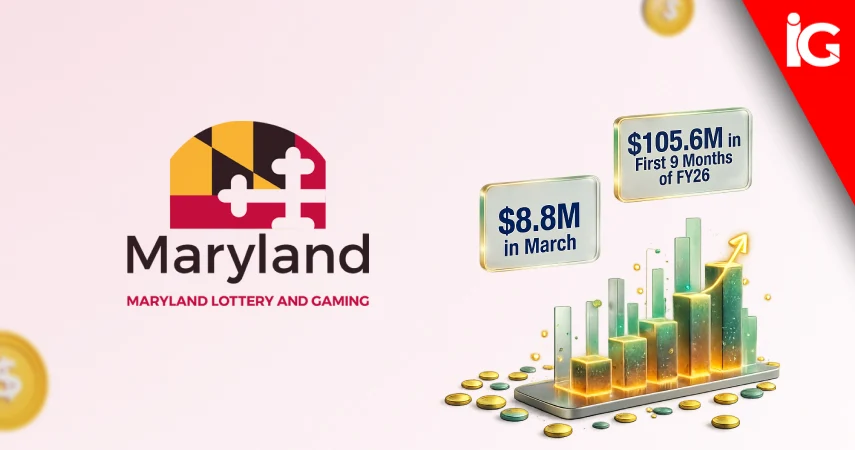
Maryland’s regulated sports betting market generated $8.8 million in tax contributions in March 2026, supported by a 10.4% hold on $604.7 million in handle. For a market at this stage of maturity, a double-digit hold stands out. It suggests a month where operator pricing held firm and outcomes leaned in their favour, even as competitive pressures remain firmly in place.
The latest result takes fiscal year-to-date contributions to $105.7 million, maintaining Maryland’s position as a reliable, mid-tier performer in the US sports betting landscape. While it does not match the scale of the largest states, it continues to deliver consistent returns, which is ultimately what matters from a regulatory and fiscal standpoint.

Margin Strength Holds Despite Ongoing Promotional Pressure
Operators reported $62.7 million in gross gaming revenue (GGR) from March’s handle. However, only $44.2 million of that figure translated into taxable win once deductions were applied. That gap remains one of the more telling indicators in the market.
Promotional spend, particularly on mobile, continues to weigh on realised revenue. Even in a month where hold exceeded 10%, operators did not fully convert top-line performance into taxable outcomes. This reflects a market where customer acquisition and retention are still being actively funded, rather than one that has fully transitioned into margin optimisation.
Sustainability of hold
At the same time, the strength of the hold cannot be ignored. Many US jurisdictions tend to fluctuate below the 10% mark over time, so Maryland’s performance points to a combination of effective pricing and favourable betting results. The question, as always, is whether this level can be sustained or whether it represents a short-term peak.
A Market Defined Almost Entirely by Mobile
The structural reality of Maryland’s betting market remains unchanged. Mobile accounts for more than 98% of total handle, with retail contributing just $9.5 million in March.

Limited role of retail
This is no longer a transitional phase; it is a settled state. Digital channels dominate both engagement and revenue generation, leaving retail with a limited role. Physical sportsbooks still have value in terms of licensing, brand visibility, and customer touchpoints, but their direct financial contribution is marginal.
For operators, this concentration reinforces the importance of mobile product quality, pricing strategy, and promotional efficiency. For regulators, it means that tax performance is closely tied to the health and behaviour of a small number of large-scale digital platforms.
Tax Structure Continues to Favour Digital Contribution
Of the $8.8 million collected in March, $6.6 million was directed to the Blueprint for Maryland’s Future Fund, while $2.2 million went to the state’s General Fund. The distribution itself is straightforward, but the mechanics behind it are more revealing.
Mobile tax rate impact
Maryland applies a 20% tax rate to mobile sports betting revenue, compared to 15% for retail. Given how dominant mobile has become, the state’s tax base is now heavily reliant on higher-taxed digital activity.
This creates a subtle but important pressure point. The same mobile revenues that are taxed more aggressively are also the ones most affected by promotional deductions. As a result, operators are navigating a model where their most valuable revenue stream is also their most exposed in terms of both cost and taxation.
Stable Long-Term Contributions, With Questions Around Sustainability
Total contributions since launch
Since launching in December 2021, Maryland’s sports betting market has contributed $257.0 million to education funding and a further $26.0 million to the General Fund. These figures point to a stable and productive framework that is delivering on its intended fiscal role.
March’s performance fits comfortably within that broader trend. There is no indication of volatility or structural weakness in the market’s ability to generate returns. However, stability at the top line does not necessarily mean efficiency beneath the surface.
Gap between GGR and taxable revenue
The ongoing gap between GGR and taxable revenue suggests that promotional intensity remains elevated. Over time, the ability of operators to maintain contributions at current levels will depend on whether that gap can be narrowed without slowing customer growth. That balance is not easy to achieve, particularly in a competitive multi-operator environment.

Operator and Supplier Takeaways
Operator challenges
From an operator perspective, March reinforces a familiar set of dynamics. Margins can still perform strongly on a monthly basis, but promotional spend continues to dilute realised revenue. At the same time, the dominance of mobile leaves little room to shift strategy elsewhere, while higher tax rates on digital activity further compress net returns.
The challenge is not new, but it is becoming more defined. Operators are effectively managing three competing forces: sustaining acquisition, improving retention, and protecting margin. Progress in one area often comes at the expense of another.
Supplier opportunity
For suppliers, particularly those focused on pricing, risk management, and bonusing tools, the opportunity is clear. The difference between GGR and taxable win is not just an accounting detail; it is a measurable inefficiency. Any solution that helps operators tighten that gap without sacrificing competitiveness is likely to find strong demand.
Overall, March does not signal a shift in Maryland’s trajectory. Instead, it reinforces the underlying structure of the market: stable, mobile-led, and still working through the long-term balance between growth and profitability.
Source: Maryland Lottery and Gaming