



CEO Patrick Dumont Powers Las Vegas Sands to $3.59B Revenue, 57% Profit Jump in Q1 2026

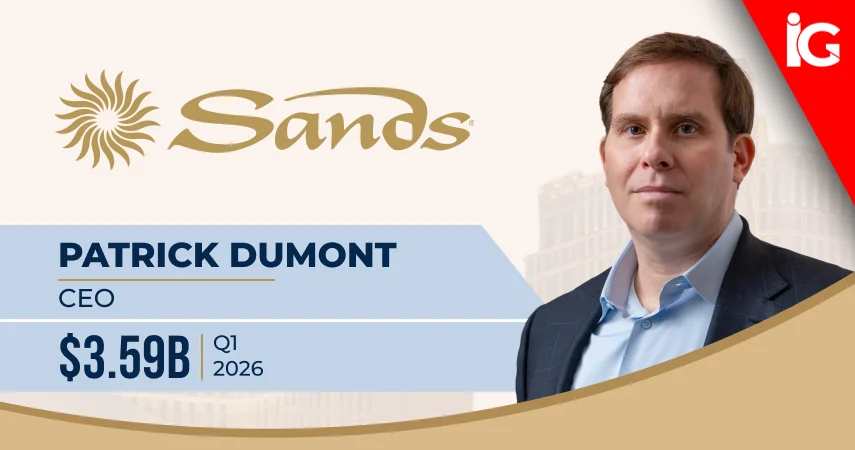
Under Patrick Dumont, Las Vegas Sands reported strong top-line and earnings growth in Q1 2026, but underlying performance diverged sharply between Singapore and Macao – highlighting a widening gap in margin quality and competitive dynamics.
Financial Performance: Growth Without Margin Expansion
Group net revenue rose 25.3% year-on-year to $3.59bn, while adjusted property EBITDA increased 24.6% to $1.42bn. Net income grew at a faster pace (+57.1%), supported by operating leverage and a more efficient capital structure.
Even so, EBITDA margin remained broadly unchanged at 39.6% (-20bps). This suggests that while revenue is expanding, incremental profitability is not scaling at the same rate – particularly outside Singapore.
Key takeaway: revenue is growing strongly, but margin expansion remains constrained.

Singapore vs Macao: Profit Engine Divergence
Marina Bay Sands (Singapore)
EBITDA reached $788m (+30.2%), with margins improving to 53.0% (+100bps). Mass gaming revenue increased 16% to $902m, and rolling volume jumped 124%.
Singapore continues to act as the group’s main earnings engine, supported by premium positioning, high-value tourism recovery, upgraded suite inventory, and effective mass-market monetisation.

Sands China (Macao)
Sands China EBITDA increased to $633m (+18.3%), but margins declined to 29.9% (-140bps). While mass market share reached 25.7%, profitability lagged.
Despite gaining share, Macao margins came under pressure, pointing to a broader shift toward lower-margin growth. This reflects stronger competition in premium mass, higher reinvestment through incentives and commissions, and the ongoing move away from VIP-driven economics.
Operator implication: Singapore remains the primary profit driver, while Macao growth is increasingly coming with thinner margins, requiring tighter cost and reinvestment control.
Mass vs VIP: Structural Rebalancing Continues
Across both markets, growth is now largely driven by mass and premium mass segments rather than traditional VIP play.
Macao mass GGR reached approximately $6.9bn (+13% YoY), while VIP volumes are still only around 31% of 2019 levels.
This transition supports more stable revenue streams, but it also puts pressure on margins due to higher operating costs and a greater dependence on non-gaming and hospitality-led spend.
Hold Dynamics and Smart Table Deployment
LVS continues to refine its “expected hold” methodology, supported by smart table technology in Singapore.
During the quarter, hold reduced its EBITDA in Singapore by around $6m, while contributing roughly $15m in Macao.
Although the direct financial impact is limited, the broader shift is operational. Data-led table management and more precise hold modelling are becoming standard, improving visibility and reducing volatility in reported performance.
Supplier implication: demand for RFID systems, table analytics, and real-time data infrastructure is likely to increase.
Capital Allocation: Returns vs Long-Term Investment
The company returned $942m to shareholders in Q1, including $740m in share buybacks and $202m in dividends. Since Q3 2023, around 75% of capital returns have come through repurchases, reducing shares outstanding by 14.3%.
At the same time, LVS is progressing with significant long-term investment plans, including an ~$8bn expansion of Marina Bay Sands (targeted for ~2031) and ~$4.5bn in Macao-related commitments through 2032.
Tension point: strong shareholder returns are being maintained alongside elevated capex commitments, increasing pressure on future capital allocation decisions.
Balance Sheet: Capacity Intact, Discipline Required
Net debt stands at $12.2bn, with net debt/EBITDA at approximately 2.2x.
While leverage remains within a manageable range, upcoming funding requirements – particularly for the Singapore expansion – will require disciplined capital allocation if market conditions become less favourable.

Commercial Outlook
Singapore is expected to remain the key EBITDA contributor in the medium term, supported by its premium positioning and ongoing asset upgrades.
Macao will likely continue to grow, but margin recovery appears limited in the near term given sustained competitive pressure in premium mass and continued reinvestment.
From a strategic perspective, investment is increasingly focused on premium hospitality, integrated resort enhancements, and non-gaming offerings, rather than expanding pure gaming capacity.
Source: Las Vegas Sands Corp.