



OneFootball Partners with Polymarket – Is Football Fandom Moving from Watching to Participation?

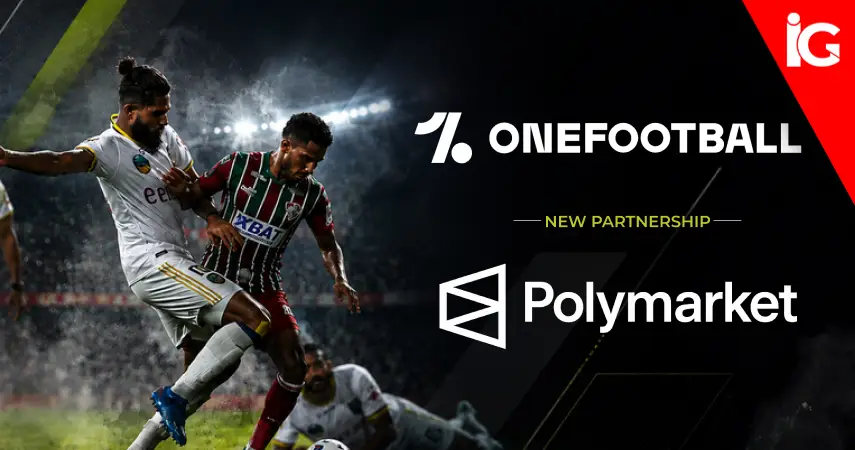
OneFootball has partnered with Polymarket to embed prediction market experiences directly inside its platform, integrating event-based forecasting across match pages, editorial content and personalised fan journeys. The integration is designed to bring predictive participation into the content environment rather than treating it as a separate destination product.
At launch, Polymarket experiences appear across match pages and editorial formats. Future phases are expected to include live prediction widgets, odds-led editorial products and in-stream prediction experiences during football broadcasts. Critically, the rollout will be limited to eligible jurisdictions and will operate in full compliance with local regulatory requirements in each market. Given that Polymarket operates under significant geographic restrictions in several major territories, including restrictions for US-based users, the precise execution of any native experience will vary by market and user eligibility.
OneFootball’s combined platform, media network and social footprint reaches more than 645 million monthly football fans globally, making this one of the largest distribution opportunities a prediction market product has secured to date.

Why the Fan Engagement Model Matters for iGaming and Sports Media Leaders
The commercial logic here extends well beyond this single deal. For operators and platform leaders, the more important question is what this partnership reveals about where interactive fan engagement mechanics are heading.
Prediction markets occupy a distinct and legally separate space from regulated sports betting. Polymarket operates as a decentralised forecasting platform, and that distinction matters both commercially and from a compliance standpoint. The behavioural mechanics, forming a view, committing to it and returning to see the outcome, share surface similarities with sportsbook engagement. But the regulatory frameworks, product architecture and legal classifications that govern them differ meaningfully across jurisdictions.
What this partnership demonstrates is that those mechanics can be embedded into content environments at scale, increasing session depth and creating stronger behavioural signals without the regulatory overhead of a licensed sportsbook integration. For iGaming founders and CMOs evaluating audience strategy, that is the dynamic worth examining closely.

Moving Beyond Affiliate Dependency: A Strategic Shift for Sports Media
The affiliate model has funded sports media for two decades. Publishers generate content, direct users toward external products and collect commission. It works, but it exports the direct commercial relationship with the user to a third party. Every conversion that exits the publisher’s environment is an engagement the publisher no longer controls.
OneFootball’s broader strategy reflects a deliberate move against that structure. The platform has been building out a fan rewards and engagement programme under the OneFootball Credits initiative, focused on token-based participation mechanics and deeper in-platform interaction. The Polymarket integration sits alongside that programme as part of a wider architecture aimed at retaining users inside the ecosystem, building first-party behavioural data and developing monetisation that does not depend on outbound referral.
For operators and media businesses evaluating similar models, the underlying logic is transferable: embed participation into the product, reduce acquisition dependency and build data loops that improve personalisation over time.
Regulatory Complexity and the Prediction Market Landscape
The regulatory dimension of this partnership deserves careful attention from anyone working in iGaming compliance, legal or market expansion functions.
Prediction markets occupy genuinely complex and often ambiguous regulatory territory. In some jurisdictions they are treated as financial instruments. In others they sit closer to gaming or wagering regulation. In several major markets the regulatory position is still actively being defined. Polymarket itself has faced significant restrictions in certain regions, and OneFootball has been explicit that the integration will only be available in eligible markets and in line with local legal requirements.
It is important to be precise here: this is not a regulated sports betting product and should not be categorised as one. The convergence being discussed is commercial and behavioural, not regulatory. Prediction markets and licensed sportsbooks remain legally distinct categories, and the operators and compliance professionals reading this will understand why that distinction matters when evaluating partnerships, products or market entry decisions in this space.

What This Signals for the Broader iGaming and Sports Engagement Industry
The wider market context makes this partnership more significant than any single integration would suggest. Across the sports and interactive entertainment space, the convergence of media consumption, predictive engagement and fan participation has been accelerating. Streaming platforms are exploring interactive formats. Sports franchises are building direct-to-consumer products that carry engagement mechanics once confined to external platforms. Media companies are rethinking what monetisation looks like when first-party data becomes more valuable than affiliate commissions.
OneFootball sits at an interesting intersection of all three trends. A media product with substantial audience reach, embedding prediction mechanics developed by one of the more prominent decentralised forecasting platforms operating today.
For operators, the strategic implication is this: the platforms likely to win the next phase of audience growth in this space are not necessarily those with the deepest promotional budgets. They are the ones building genuine participation into the product experience, reducing dependency on paid acquisition channels and creating data loops that improve over time.
OneFootball and Polymarket have outlined an engagement architecture that the broader industry will be studying carefully over the next few years.
The template remains more interesting than the deal itself.
Source: OneFootball