



ADGM FSRA and GCGRA Sign MoU to Strengthen UAE Regulatory Cooperation

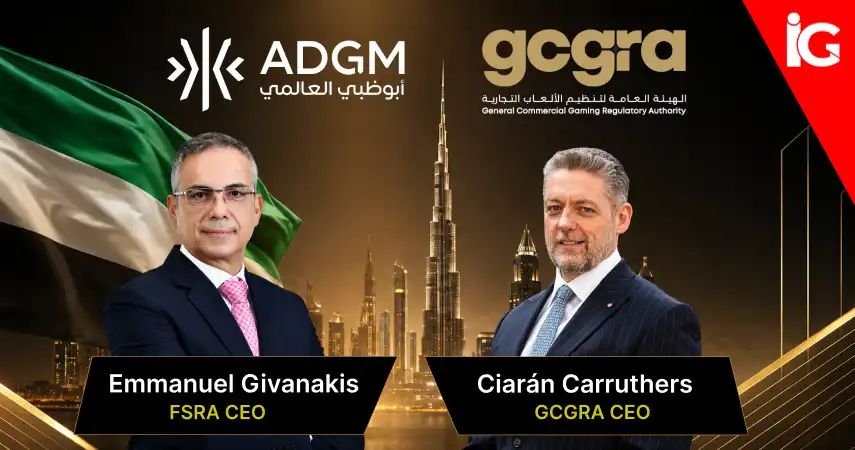
A financial regulator and a gaming regulator now share a defined channel to supervise the same market. In a sector this young, the timing is the story.
ADGM’s Financial Services Regulatory Authority has signed a Memorandum of Understanding with the General Commercial Gaming Regulatory Authority, the UAE’s federal regulator for commercial gaming. The ADGM FSRA GCGRA MoU, announced on 14 August 2026, sets up a formal framework for regulatory cooperation and the exchange of information in support of each body’s supervisory responsibilities. No enforcement action. No operator names. Just infrastructure. And it lands as the UAE moves toward a regulated online gaming framework built around one licence per emirate, which is exactly the kind of market that needs its regulatory wiring in place first.

Infrastructure, laid early, tends to say more about where a market is heading than any single licence would.
Inside the FSRA and GCGRA cooperation framework
The agreement gives both authorities a defined route to work together. It covers supervisory coordination, policy dialogue, investigative assistance and the exchange of regulatory information, all in line with applicable laws and confidentiality requirements. Each authority keeps its own independent statutory mandate. This is coordination, not a merger of remits.
The framing is deliberate. The MoU reinforces both authorities’ commitment to high regulatory standards through collaboration, information sharing and coordinated engagement. It also aims, in their words, to strengthen regulatory certainty for market participants operating within ADGM and the wider UAE financial ecosystem.
Why the UAE gaming sector needs this channel now
Commercial gaming is new ground for the UAE. Carruthers said as much.

“Commercial gaming is one of the newest regulated sectors in the UAE, and its credibility will be built through exactly this kind of cooperation,” said Ciarán Carruthers, Chief Executive Officer of the General Commercial Gaming Regulatory Authority. On what the agreement does in practice, he added: “This MoU gives GCGRA and the FSRA a clear channel to share information and coordinate supervision where our respective mandates intersect, which matters as the sector grows and the range of participants operating in and around it becomes more complex.”
Sit with that last phrase. A gaming operator is rarely just a gaming operator. It moves money, holds accounts, plugs into payment infrastructure, and lives inside a financial ecosystem the FSRA already watches. When a sector is young, the seams between regulators are where risk hides. This MoU stitches one of them.
The need is not theoretical. Platforms have already surfaced in the country operating in a regulatory grey area ahead of any published online gambling law , which is precisely the sort of gap a shared supervisory channel exists to close.
From the FSRA side, Emmanuel Givanakis, Chief Executive Officer of the Financial Services Regulatory Authority of ADGM, framed it as keeping frameworks current: “Effective collaboration between regulators is fundamental to preserving market integrity, addressing emerging risks and ensuring that regulatory frameworks evolve alongside innovation.”
Read both quotes together and the message is consistent. Neither regulator is claiming a problem exists. Both are saying the connective tissue should be in place before one does.
What the agreement changes for operators
For anyone weighing the UAE, the practical value is predictability. A defined cooperation channel between the financial and gaming regulators means fewer surprises later, fewer contradictory signals, and a clearer sense of who supervises what. That shapes real decisions: where to base entities, how to build a compliance function, how much regulatory friction to price into market entry.
It sets a tone, too. Jurisdictions that assemble their oversight architecture deliberately, ahead of scale, are usually the ones that mean to be taken seriously. The UAE is positioning itself that way rather than competing on how loose it can be.
The limits of an MoU
An MoU is a framework, not an outcome. It commits two authorities to cooperate. It does not, on its own, license a single operator or settle a single supervisory question. Its value shows up in how the two bodies actually use the channel, and that won’t be visible from outside for a while. Reading too much into a cooperation agreement is a familiar trap. A foundation is not a finished building.
What the FSRA–GCGRA MoU could bring next
Licensing is the next signal. As the UAE’s commercial gaming framework fills in over the coming months, this MoU becomes the mechanism that keeps financial and gaming oversight moving in step rather than in parallel. If the participant base widens the way Carruthers expects, the channel’s value gets clearer, and more cooperation agreements of this kind are the logical next step as the regulatory picture completes.
Source: ADGM