


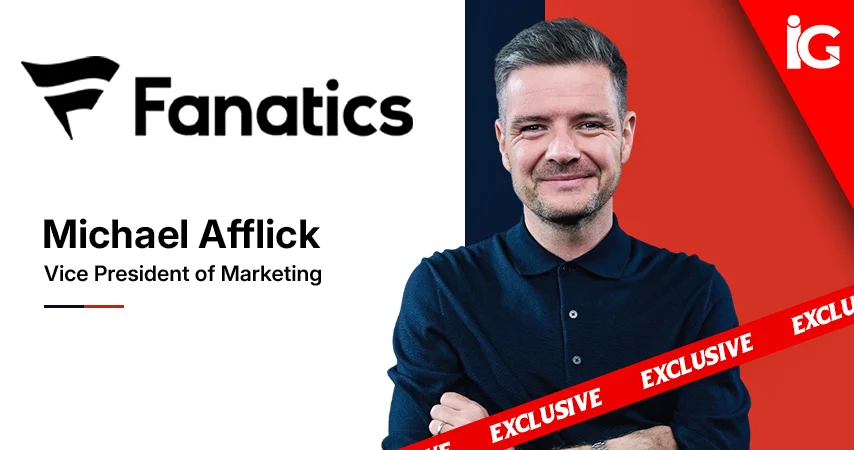
Exclusive: Michael Afflick on Why the Strongest Gaming Brands Have a Point of View, Not Just a Product

In a market where products, promotions and technology can increasingly be replicated, building a brand that customers genuinely connect with has become a more complex challenge.
For Michael Afflick, Vice President Brand Marketing at Fanatics, the answer starts with something that is much harder to copy: having a clear point of view.

In this exclusive interview with iGaming News Today, Afflick reflects on the marketing lessons that shaped his career, from Paddy Power’s customer-led approach to the importance of authenticity in sports sponsorships.
1. You began your career at Everton Football Club before moving into gaming marketing. How did that early experience in sports and partnerships influence the way you approach brands today?
Michael Afflick:
I never originally intended to move into iGaming or even marketing. I studied law at university, and my first role was in commercial contracts at Everton Football Club. One of the club’s partners was Paddy Power, and I became interested in coming up with ideas for businesses that were investing heavily in sports sponsorship.
At the time, Everton did not really have a dedicated marketing team, so I found myself working with partners and thinking about how they could use their sponsorship rights and make the most of their investment. That gave me an understanding of both sides: the rights-holder perspective within sport and the commercial perspective of the business using those rights.
When I was eventually offered the opportunity to join Paddy Power, I initially turned it down several times because I was a huge Everton fan. However, moving to Dublin and taking that opportunity became one of the best career decisions I have ever made. It gave me a strong foundation in partnerships, marketing and understanding how brands can create value beyond simply buying exposure.

2. You have worked with brands such as Paddy Power, Sky Bet, William Hill, Mr Green and Fanatics. What have these different experiences taught you about building a strong identity in a competitive market?
Michael Afflick:
The most important lesson is that a brand needs to have a clear point of view. You need to understand what you stand for and why a customer should care.
Every business I have worked with approached this in a different way, but the principle remained the same. You can have the best product in the market, but someone will eventually copy it. You can create the best promotions, but competitors will eventually catch up. What is much harder to copy is your point of view, how you show up, and the reasons customers believe in your brand.
That is what makes a business stand apart. Without a clear identity, you become just another company offering similar products and promotions. A strong brand needs to communicate a distinctive perspective and consistently deliver on it. It is not only about what you sell; it is about the relationship you build with the customer and the reason they choose to engage with you instead of someone else.
3. Paddy Power became well known for its bold and sometimes unexpected marketing. How do you balance creativity and humour with the need to protect a brand’s reputation?
Michael Afflick:
The way I describe Paddy Power’s point of view is that it was always on the side of the customer. Its communication and offers were built around understanding what customers were talking about.
The brand would then build its marketing and offer plan around conversations. This approach existed well before social media became such a powerful marketing channel.
One of the most valuable lessons I learned was that a brand should aim to sit on the edge. You want to go far enough that you annoy a few people and get noticed, but not so far that you actually do something wrong or damage the business. Sometimes you may go slightly too far in one direction, or not far enough in the other, but the objective is to consistently find that sweet spot.
For me, the most important part is remaining on the customer’s side. If you are having the same conversation as your audience, you become part of that conversation. If you are not, you are simply talking to yourself.
4. You have also worked across major sponsorships and sports partnerships. What makes a sponsorship successful, and how can brands make it more meaningful than simply placing a logo on a shirt?
Michael Afflick:
Authenticity is the most important factor. Anyone can write a cheque to buy space for a logo, but a successful sponsorship needs to have a genuine reason behind it. There must be an authentic connection between the brand, the partnership and the audience that the agreement gives you access to.
A good example was Sky Bet’s sponsorship of the York Ebor. At the time, it was one of the biggest racing festivals but was relatively underappreciated at a national level. That created an opportunity to do something interesting and build a stronger platform around it.
There was also a genuine local connection. Sky Bet was a Yorkshire-based business and that gave us a real reason to become a partner and build something long term.
Of course, we paid for the sponsorship and received inventory in return. But the reason we entered the partnership, and the way we activated it, was genuine. That is what made it work. The strongest sponsorships become part of the audience’s experience rather than feeling like traditional advertising.
5. Fanatics has a strong connection with sports fans and culture. What opportunities do you see in bringing sports, entertainment and betting together to create a stronger customer experience?
Michael Afflick:
There is a significant overlap between sports fans, sports bettors and certain segments of the online gaming audience. Bringing those interests together can create a more engaging experience, particularly when the sports element adds value to something the customer already wants to do.
At Fanatics, the mission is to relentlessly enhance the fan experience. That comes from the very top of the organisation, and everything we do is focused on making the relationship with the fan deeper and stronger for both sides.
From a casino perspective, the same principle applies. It is about understanding what the customer enjoys and using the assets, content and experiences available to make that journey better. Sports, entertainment and betting should not feel like separate experiences forced together. They should connect naturally and give the customer additional reasons to engage with the brand.
Of course, that only works if it’s done responsibly – engagement has to be built on trust, and that means giving customers an experience that respects them, not just one that’s exciting.
The opportunity is to use the emotional connection people already have with sport and culture to create a more meaningful and personalised entertainment experience, in a way that’s sustainable for the customer and the brand alike.
6. Customer expectations are changing quickly across digital platforms. How can gaming brands stay relevant while maintaining a clear and consistent identity?
Michael Afflick:
Brands need to remain authentic to what they offer and understand what their customers actually want. Building a brand beyond tangible products and promotions is important, but businesses must not lose sight of the core experience they provide.
Gaming gives customers something to do in their downtime. It offers entertainment, an escape from everyday life and the flexibility to engage whenever they want. Unlike sport, which is tied to a kickoff or race start time, online gaming can be accessed whenever it suits the customer – which is exactly why it has to be offered in a responsible way, giving customers control over how and when they play.
The key is bringing together an understanding of who the customer is, what they want and what the brand offers. Those things should support each other rather than create friction.
I also strongly believe brands need to meet customers where they are instead of always expecting customers to come to them. Too many gaming brands use social media as a traditional advertising platform, constantly telling people what they offer and hoping they will respond.
A better approach is to engage with customers in the spaces and conversations they already occupy, creating natural interest in the brand. At Fanatics Casino, we are still relatively early in our journey, with our standalone casino app having been live for less than two years.We have a clear strategy, and we’re excited about what’s ahead as we execute on it.
7. How do you see AI changing the way marketing teams develop ideas, understand audiences and create campaigns over the next few years?
Michael Afflick:
AI fascinates me, and I am enjoying the journey both professionally and personally. It has already changed many aspects of my working life and personal life, largely for the better.
At a fundamental level, I believe AI should make great people better at what they do. I do not see it as something that should automatically replace people. Instead, I want it to help talented teams increase their output, explore more ideas and improve the quality of their work.
For example, if I think about our creative team, craft is irreplaceable – no tool changes that. Businesses still need people who understand quality, judgement and what good looks like. We have had automation and creative tools for years, but without strong creative thinking and quality assurance, customers will notice.
Where AI comes in is amplifying that craft. I want AI to make each person feel as though they can produce five times the amount of creativity, explore five times as many ideas and deliver a much greater level of output. The goal should be to help people become more capable and more effective.
If AI feels like it is simply a tool that will eventually replace you, people will work with fear rather than confidence. That will prevent them from thriving.
The future is about finding the right balance. AI feels like it has potential to be a hugely positive development, but it should be used to strengthen human creativity rather than replace the need for it.
8. What advice would you give to people who are beginning their careers in gaming, sports betting or marketing?
Michael Afflick:
I’d give you three pieces of advice.
Find a great mentor. Look for someone in gaming, sports betting or the wider business world whom you respect and trust – learn how they think, how they work, how they approach challenges.
Outwork everyone. I’m not necessarily the cleverest, smartest or most creative person in the room, but I will keep going until I find a solution, and I don’t stop until I do.
Surround yourself with good people – and hire people who are better than you. My team are phenomenal, and several of them could easily do my job. That’s not a threat; it’s a sign you’ve built something strong.
You can achieve a lot when you have talented people around you, good mentors and the willingness to keep learning. The gaming industry is a great place to build a career because it brings together creative, commercial and technology-focused people. I have enjoyed every stage of my journey, and I expect to remain in the industry for a long time.
About Fanatics
Fanatics is a global digital sports platform and sports-focused consumer brand with businesses spanning licensed sports merchandise, collectibles, sports betting and online gaming.
Through its gaming operations, Fanatics has expanded its presence across sports betting and casino, bringing its wider sports-fan ecosystem into digital gaming. Fanatics Casino is part of this broader strategy, connecting casino entertainment with the company’s established relationship with sports fans and culture.
The company’s wider proposition is built around the fan experience, with sports, entertainment, commerce and digital products operating across its ecosystem.