


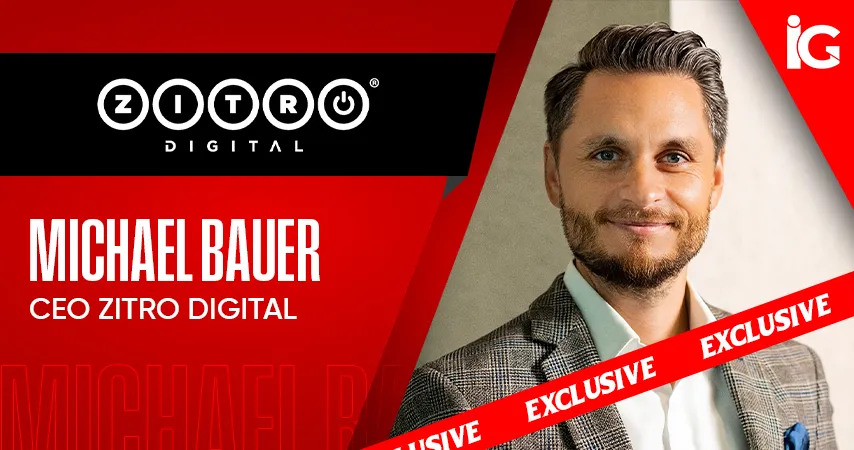
Exclusive: Zitro Digital CEO Michael Bauer on AI, Regulated Growth and the Future of iGaming

As the global iGaming industry continues to evolve, operators and suppliers are navigating a landscape shaped by artificial intelligence, expanding regulation, and increasing competition. While technology is creating new opportunities, long-term success still depends on understanding player needs, entering the right markets, and building products that stand out.
In this exclusive interview with iGaming News Today, Zitro Digital CEO Michael Bauer reflects on his journey through the gaming industry, discusses the opportunities created by regulated markets, shares his perspective on AI, and explains how companies can build sustainable growth in an increasingly competitive environment.

Q1: Can you walk us through your journey first – before and now?
Michael:
My journey in gaming began in 2013 with two years in traditional, land-based gaming at Novomatic, a foundation that gave me a deep understanding of what players truly enjoy. In 2015, I joined Greentube as CFO, and two years later, I took over the entire B2B business. From there, I had the privilege of building it into a substantial operation: bringing land-based games online, expanding the studio network, and entering new markets across Europe, the US, and South Africa. It was a rewarding experience focused exclusively on regulated markets, where the standards are high, and the player experience really matters.
When the opportunity at Zitro Digital came along, I didn’t hesitate. Zitro is one of the most recognized names in the industry. As the undisputed leader in land-based gaming across Latin America, with a strong presence in Mexico, Argentina, Peru, Colombia, as well as European countries such as Spain, and an expanding footprint in North America and Asia, the potential here is enormous. The vision is to take that proven land-based success and translate it into the online world, and I joined in January to help lead exactly that. It is an ambitious but very achievable goal, and we are making strong progress across multiple fronts.
On the market side, we are already active across Latin America and growing our presence with major operators, which represents a significant opportunity for us. Brazil is a particularly exciting focus. It is not only one of the largest and most dynamic markets in the region, but also deeply meaningful for Zitro; this is where the company’s roots are and where video bingo was born. We are entering the online space there with real momentum, and I fully expect we will establish a leading presence quickly.
Mexico and Argentina are among Zitro Digital’s most established markets, and momentum is building across the region.

Q2: As CEO at Zitro Digital, what do you think is the biggest opportunity for growth in the iGaming industry today?
Michael:
If we focus specifically on regulated business, where we operate, the biggest opportunities lie in markets with room for regulatory expansion and long-term stability. In Europe, most major markets are already regulated, with France as the only major market still missing. Beyond that, Europe offers limited new market growth and is increasingly competitive, with regulation becoming more complex rather than easier.
For both suppliers and operators, the most important thing is stability – a stable and reasonable regulatory environment. The challenge is that when rules keep changing, companies are forced to redesign products and introduce new compliance features, which ultimately does not improve the player experience.
From a market perspective, I still see clear growth potential in the US, as only a limited number of states have regulated iGaming to date. I also believe there is a significant opportunity in emerging markets across Asia and Africa if further regulation is introduced there. Those markets could represent substantial growth for the industry.
From a technological perspective, growth also tends to come when there is a major shift in how products are built and delivered. We saw that previously with the transition from desktop to mobile. Today, the next major shift is AI. I believe AI will help level the playing field to some extent, because smaller companies that use it intelligently can increase output quickly and compete more effectively with much larger players. That will make the market even more competitive. At the same time, companies will still need creative people with a real understanding of what makes a game appealing to players. AI can support decision-making through statistics and analysis, but the strategic vision behind the product still matters.
Q3: How do you see AI influencing product development and player engagement in iGaming?
Michael:
On the product development side, AI is already being used in visible ways. The simplest example is graphics, where it is increasingly easy to identify content created or influenced by AI. Animation is likely the next step, with lightweight animations eventually being generated in the same way. On the coding side, AI-assisted development can clearly improve efficiency, and that extends into testing and automation as well.
Operationally, AI can also play a major role. For example, if you look at a live integration running with an operator, much of the monitoring can be handled by AI agents rather than requiring a person to watch dashboards around the clock. That creates major efficiencies across operations.
On the player engagement side, much of the opportunity lies with operators. AI can help analyze player preferences, identify when players are likely to leave a game, and improve how content is surfaced. I am a strong believer in a more curated content strategy. If I were running an operator, I would not launch large volumes of games simply for the sake of volume. I would launch fewer, stronger games that are better aligned with the target audience’s preferences. Right now, players can easily get lost in the number of new releases entering the market.
AI should increasingly help solve that by filtering content based on individual player preferences. It can also support real-time marketing and bonusing strategies—for example, identifying when a player is at risk of churning and triggering an incentive at the right moment. That is where I think AI can have a significant impact on engagement.
Q4: What should companies focus on when entering a new market successfully?
Michael:
The first step is understanding your own strengths and identifying your USP in that market. Especially for smaller suppliers, it is impossible to have content that fits every market, because player preferences vary significantly from one region to another. So, the first question should always be whether you have product-market fit for that market.
From there, you need to assess the market more structurally. That includes factors such as taxation, licensing requirements, certification requirements, the cost of entry, the competitive landscape, and overall market size. All these influences determine whether a market is worth entering and how high the barriers to entry really are.
To give two examples, entering the US is expensive because it typically requires everything—a license, personal licenses, game certificates, and a local server center. By contrast, entering a market such as Malta is much easier, because the requirements are lighter and, in some cases, may be limited to certification. That creates a very different cost and complexity profile.
Market size also matters. A larger market, such as Italy, is naturally more attractive than a smaller one. But even then, you must weigh that against the regulatory burden. Germany is a good example of that. It is a large country, but the regulated market is relatively small, and product restrictions are significant, requiring a heavy investment to adapt the product. Once you compare those costs with the actual size of the regulated opportunity, the market can become much less attractive than it appears on paper.
Q5: Do you think changing market conditions and uncertainties could affect growth and investment across the iGaming industry?
Michael:
Absolutely. We have already seen examples of this, such as the UK gaming tax increase, on top of earlier regulatory restrictions that had already reduced the market’s attractiveness. Over time, that has made the UK less profitable and less attractive than it was several years ago. Five years ago, I would have ranked the UK very highly in a market attractiveness matrix. Today, I would not. Product restrictions are tighter, taxation is higher, and competition remains intense, which makes the economics much less appealing.
More broadly, both operators and suppliers need stability. It takes significant effort to build products that work well in each market. If the rules keep shifting, businesses are forced into a constant cycle of regulatory catch-up rather than focusing on what really matters: the player experience. At the end of the day, this is an entertainment business. The goal should be to deliver the best possible experience for players, and frequent regulatory disruption makes that much harder.
Q6: What major changes do you expect in the iGaming industry by 2026?
Michael:
In the short term, I do not expect dramatic changes in the markets where we are currently active, and frankly, I hope there are not too many. There have been recent tax changes in markets such as Colombia that have negatively affected operator profitability and, by extension, supplier performance.
I do not currently see any major new US states coming online in the immediate term, and I also do not see major positive developments in Europe in the near future. For now, the main hope for 2026 is stability.
Looking slightly further ahead, we would of course like to see more US states regulate iGaming, and we would also like to see France regulate eventually. At the same time, the industry needs to avoid further negative developments such as additional product restrictions, tax increases, or tighter marketing limitations. Marketing remains a critical tool for driving players towards regulated brands, and if that becomes more restricted, it creates an even bigger challenge for the regulated market.
Q7: How do you personally maintain balance outside of work, and what do you enjoy listening to on Spotify?
Michael:
Outside of work, I try to stay active through sport, because that helps me stay mentally fresh. Living in Barcelona makes that easier; it is a great place for running, cycling, and swimming in the sea, so that is a big part of how I maintain balance.
In terms of music, I have probably been influenced a bit by being in Barcelona, but lately I have been listening to Bad Bunny. Beyond that, I also listen to more relaxed house music at home when I want to unwind.
Q8: What advice would you give to someone looking to build a long-term career in the iGaming industry?
Michael:
The most important thing is to be open to change, because this industry is constantly evolving. If someone does not cope well with change, this probably isn’t the right industry for them. Particularly in leadership, you always need to keep asking whether you are still doing things the right way, whether processes need to change, and whether products need to improve. If you stand still for too long, you quickly fall behind.
Stress resistance is also important because there is a great deal of pressure in the industry, regulatory changes, new deadlines, and constant market shifts. At the same time, it helps to be open-minded and communicative. Even though the industry has matured over the years, it is still relatively young, highly connected, and full of idea exchange.
And beyond all of that, one principle still applies: work hard. That is not specific to gaming – it is true in any industry. Nothing comes for free.
About Zitro Digital
Zitro Digital is the online gaming division of Zitro, one of the world’s leading gaming suppliers renowned for its success in the land-based casino sector. Building on Zitro’s strong heritage across Latin America, Europe, North America, and Asia, Zitro Digital delivers a growing portfolio of premium online casino content designed for regulated markets. Combining proven land-based performance with innovative digital experiences, the company partners with leading operators worldwide to provide high-quality games, localized content, and technology-driven solutions that enhance player engagement and support sustainable growth across global iGaming markets.