



$1.3B Acquisition: IG Group Acquires Underdog to Lead the Future of US Prediction Markets

A FTSE 100 trading house is buying its way into US prediction markets – and the licence stack matters as much as the price.
IG Group has agreed to acquire Underdog, a leading US daily fantasy sports and prediction markets operator, for total consideration of up to approximately $1.3bn. The IG Group Underdog acquisition pushes the FTSE 100 firm into one of the fastest-growing corners of US trading and entertainment, and marks a decisive outcome of the strategic review IG launched in March. Completion is expected in late 2026 or early 2027, subject to US regulatory approvals.

What the IG Group Underdog acquisition actually involves
The structure is worth reading closely. The upfront consideration is based on an enterprise value of around $1.1bn, equivalent to an upfront equity value of roughly $963m. IG will settle that by issuing about 24.1 million new shares – around 6.8% of its enlarged capital, covering 60% of the upfront equity value – plus about $380m in cash. It will also repay around $160m of Underdog’s existing debt. On top sits an earnout of up to approximately $200m, payable to Underdog’s shareholders against 2026 net gaming revenue targets and conditional on Underdog achieving positive 2026 EBITDA.
Then there’s a separate management incentive plan for Underdog’s team, capped at $850m. It is self-funded from Underdog’s earnings, and the maximum only pays out if the business delivers EBITDA of at least $400m in 2028 and $700m in 2029. Steep targets. Deliberately so.
Why Underdog, and why now
Founded in 2020, Underdog is the second-largest US daily fantasy sports operator by revenue, behind PrizePicks. But the real prize is what it did next. Since launching prediction markets in September 2025, it has become the third-largest US venue by regulated notional volume across both prediction markets and DFS combination trades, behind only Kalshi and Robinhood.
The mechanism behind that rise is regulatory, not just commercial. Traditional DFS is treated as a game of skill and regulated state by state, which caps the formats an operator can offer. Prediction markets, run as CFTC-regulated event contracts, allow simple positions on outcomes across roughly 50 states under a single federal regime. Underdog assembled a full vertically integrated licence stack – brokerage, exchange, and clearing house – and migrated its existing customers onto those rails with, in its own account, no friction: same app, same wallet, same brand.

For IG, that translates into scale it could not build quickly on its own. Underdog brings more than five million depositing customers, over 11 million registered accounts, and around one million average monthly active users. IG says the deal will more than double its US revenues and lift US monthly active customers more than tenfold.
The operator read
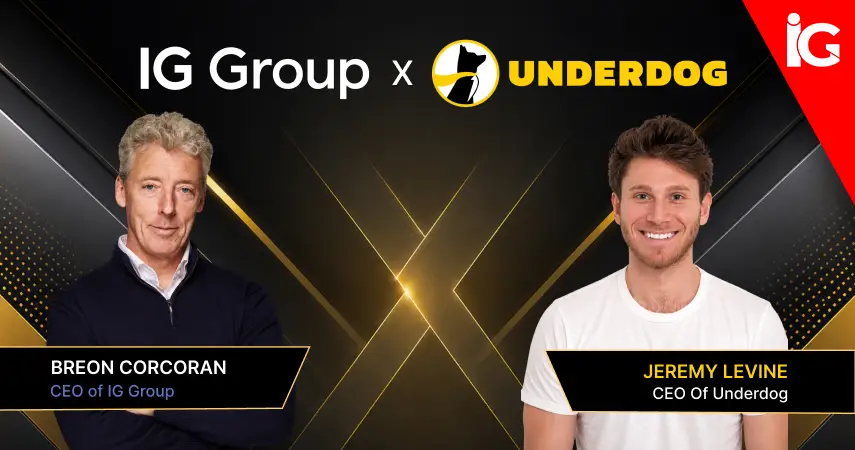
Here’s what a platform head should take from this. IG isn’t paying $1.3bn for fantasy sports revenue. It’s paying for a pre-converted, mobile-first sports audience and the federal infrastructure to serve them nationally – a bridge from sport into active trading. IG CEO Breon Corcoran put it plainly: “Technology is reshaping the large, high-engagement markets in which IG operates – and increasingly bringing them together.”
Underdog CEO Jeremy Levine, who previously founded DRAFT and StarStreet, framed it from the product side: “We built Underdog by creating the best experience for fans, and we’ve proven we can build the best products no matter how the regulatory landscape shifts.” Underdog will run as a standalone brand, with Levine reporting directly to IG’s CEO.
The strategic signal for the rest of the industry is that convergence between trading, DFS, and sports betting has moved from panel discussion to M&A thesis. Anyone holding a sports-native audience and a route to federal event contracts has just become a more interesting target.
The caveat worth naming
Two points belong on the record. First, the deal carries a governance disclosure IG made itself: CEO Breon Corcoran holds a personal investment in Underdog of around 0.34% (acquired in 2021 and 2023, before he joined IG) and was an early-stage investor. The Board noted his interests, and Corcoran recused himself from its formal approval of the transaction, though he remained involved in negotiations and supports the deal. The Board says it unanimously backs the acquisition.
Second, IG’s own announcement flags the evolving regulatory landscape for prediction markets and daily fantasy sports as a risk. The category’s federal footing is powerful precisely because it is new – and newness cuts both ways. Underdog’s financials here are unaudited management figures.

What operators should watch before completion
The near-term milestones are clear: US regulatory approvals, including clearance under the HSR Act, with completion targeted for late 2026 or early 2027. The earnout of up to around $200m hinges on Underdog’s 2026 net gaming revenue and on the business posting positive 2026 EBITDA. IG has paused share buybacks and expects to resume them in 2027. Beyond sport, IG points to the same infrastructure supporting contracts on crypto, financial, and cultural or political outcomes – a materially larger market, though one it frames as an option to consider rather than a commitment. IG will set out fuller strategy and guidance at an update on 22 October 2026, which is the next date the market should watch.
The bet, in the end, is that the customer who drafts a fantasy line-up and the one who trades an event contract are increasingly the same person. Whether the regulators see it that way is the question the next year will answer.
Source: IG Group