



$744M Revenue. 62.8% DTC Growth. Bigger Ambitions – Under Robert Antokol, Playtika Is Scaling Beyond the App Store Era

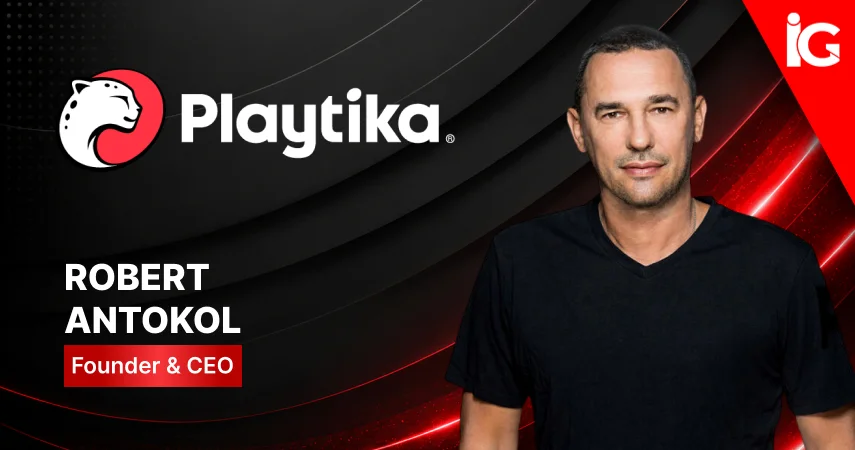
Playtika raised its full-year 2026 guidance after first-quarter revenue increased 5.5% year-on-year to $744.7m, supported by accelerating direct-to-consumer (DTC) monetisation and strong growth from Disney Solitaire. The company lifted its annual revenue outlook to $2.75bn-$2.85bn from a previous range of $2.70bn-$2.80bn, while adjusted EBITDA guidance was increased to $750m-$790m.
The quarter reinforced the growing strategic importance of DTC infrastructure across the mobile gaming sector. Playtika’s DTC revenue climbed 62.8% year-on-year to a record $291.8m, continuing the broader industry migration away from app-store payment ecosystems. Mobile publishers are increasingly directing transactions through proprietary payment channels to reduce platform fees, improve payer economics, and gain greater ownership of customer relationships.
The company also recorded 9.7% sequential revenue growth, indicating continued momentum despite softer trends across parts of its legacy portfolio. Management highlighted ongoing stability improvements within the core business while continuing to scale newer growth assets.

Margin Pressure Intensifies as Spending Rises
Despite stronger topline performance, profitability weakened significantly during the quarter as Playtika accelerated user acquisition and integration spending tied to SuperPlay.
Adjusted EBITDA fell 25.2% year-on-year to $125.2m, while EBITDA margin contracted to 16.8% from 23.7% a year earlier. Operating results swung to a $49.6m loss compared with operating income of $67.8m in Q1 2025.
Sales and marketing expenses rose sharply to $360.6m from $271.8m, underlining the escalating cost of scaling mobile titles in an increasingly competitive acquisition environment. General and administrative expenses more than doubled year-on-year to $143.5m, partly reflecting acquisition-related charges and contingent consideration adjustments connected to SuperPlay.

Playtika reported a GAAP net loss of $57.5m, compared with net income of $30.6m a year earlier. Management attributed much of the decline to non-cash remeasurement impacts tied to SuperPlay earnout obligations. Adjusted net income reached $13.6m for the quarter.
The results highlight a familiar challenge across the mobile gaming market: publishers continue relying heavily on aggressive user acquisition spending to sustain growth, even as customer acquisition costs remain elevated across mature app ecosystems.
Disney Solitaire Emerges as a Key Growth Engine
Disney Solitaire was the standout performer during the quarter, generating $123.3m in revenue after 72.1% sequential growth. The title’s rapid scaling suggests Playtika may be establishing a meaningful growth franchise outside its mature social casino segment.
The diversification is increasingly important as some legacy franchises continue to soften. Bingo Blitz revenue declined 5.4% year-on-year to $153.7m, reflecting ongoing pressure within more mature social casino categories. Meanwhile, June’s Journey delivered comparatively resilient performance, with revenue rising 10.4% year-on-year to $76m.
User metrics presented a mixed picture overall. Average daily active users declined from 9 million to 8.6 million year-on-year, while monthly active users fell from 31.8 million to 30.1 million. However, payer conversion improved to 4.5% from 4.3%, and ARPDAU increased to $0.94 from $0.87.
The data points to improving monetisation efficiency among retained users, reinforcing the broader industry shift toward higher-value payer monetisation over pure audience scale.

Balance Sheet Remains Stable Despite Cash Flow Pressure
Playtika ended the quarter with $779.2m in cash and short-term liquidity against $2.38bn in long-term debt. Free cash flow remained limited at $2.6m as investment spending, software capitalisation costs, and financing obligations continued to weigh on cash generation.
The company also confirmed the appointment of Tae Lee as chief financial officer following his period as acting CFO.
For the wider mobile gaming sector, Playtika’s quarter reflects two major trends increasingly shaping publisher strategy: continued migration toward direct payment ecosystems and sustained dependence on large-scale acquisition spending to drive growth in an increasingly mature market.
Source: Playtika