



When a Sales Chief Wins Positive Role Model of the Year, the Story Is Usually Bigger Than the Award. Ani Mkrtchyan Won It at WiG 2026

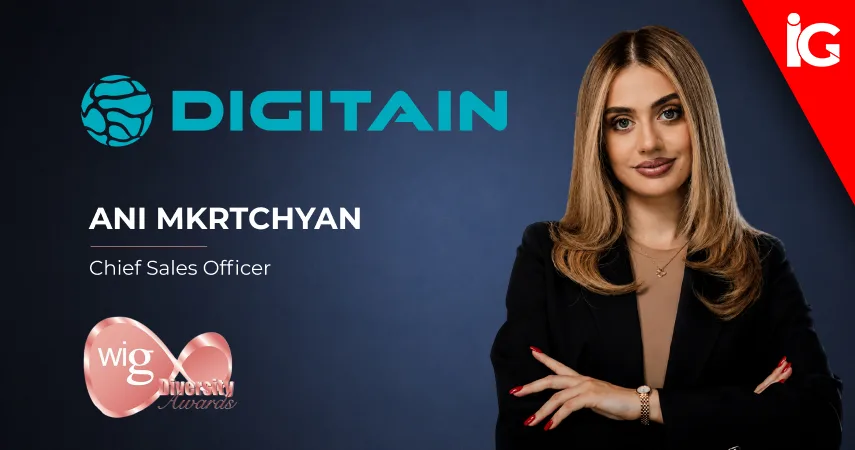
Digitain’s Ani Mkrtchyan took Positive Role Model of the Year at WiG 2026, and the category tells you more than the trophy does.
Awards in this industry usually celebrate a product, a launch, a record quarter. This one went to a person, and specifically to the culture she sets around her. Ani Mkrtchyan, Chief Sales Officer at platform supplier Digitain, has been named Positive Role Model of the Year in the Supplier Category at the WiG Diversity Awards 2026, announced on 19 June. The timing is worth a glance. It comes off the back of a busy stretch for the supplier, which has been pushing hard into regulated European markets, most recently picking up a Denmark licence. A people award in the middle of a commercial growth run says something, and it is worth examining.

The award
The WiG Diversity Awards exist to highlight organisations that put wellbeing and diversity at the centre of how they operate, and the part culture plays in keeping a business healthy over the long run. The Positive Role Model category rewards individuals who lead by example rather than by title.
Mkrtchyan’s approach, as Digitain describes it, brings together clarity, collaboration, and accountability. The company frames her leadership as building an environment where teams are trusted to perform, grow, and step into leadership themselves. Digitain says it defines leadership by measurable impact and the ability to lift others, and points to Mkrtchyan as someone who runs the commercial side of the business on exactly those terms.
That is the official line. The more interesting story is what the recognition implies.
Why this one is different
Most awards in this industry celebrate a thing. A product. A launch. A record quarter. This one celebrated a person, and specifically the culture she sets around her.

That distinction matters more on the supplier side than people tend to admit. A supplier’s value to an operator is not only the platform or the games. It is the relationship. And the relationship is run, ultimately, by the people in commercial roles. The tone a sales leader sets internally rarely stays internal. It shows up in how a deal is negotiated, how an integration problem gets handled at two in the morning, how a partner is treated in the months when results are thin.
You can see the commercial side of that culture in the deals themselves. The team Mkrtchyan leads has been steadily closing market entries, including a recent expansion into Romania through a partnership with Winbet. Deals like that get signed by people, not slide decks. So when the head of sales wins an award built around how she treats people, that is not a soft data point. It is information.
What an operator does with this
Here is the practical frame. When an operator evaluates a platform partner, the assessment usually leans heavily on the tech stack, the content library, the commercial terms. The people running the account get treated as a secondary factor, the soft stuff you sort out later.
That gets the weighting wrong. Plenty of technically capable suppliers lose accounts not because the product failed but because the relationship did. The account manager went quiet. The escalation went nowhere. The partner stopped feeling like a priority. A commercial culture built on accountability and trust is the thing that prevents that, and it is far harder to fake than a feature list.
For a content director or platform manager reading this, the takeaway is concrete. When you sit across from a supplier, weigh the people on the other side of the table, not just the slide deck. Recognition like this is one of the few external markers you get of how a vendor actually behaves once the ink is dry.
The honest caveat
None of this should be read as a guarantee. An individual award, however earned, describes one leader and one moment. Culture at a supplier is set by many people across many functions, and a single recognition cannot speak for an entire organisation or predict how a partnership plays out under pressure. Operators should treat it as a signal, not a substitute for due diligence.
It is also true that awards coverage in this sector can blur into promotion. The value here is not the trophy. It is what the category itself rewards, and what that says about where the industry is starting to look when it defines good leadership.

What comes next
Expect the supplier tier to keep moving in this direction. As platforms converge on similar feature sets, the differentiators that survive are increasingly human ones, the quality of service, the strength of the relationship, the people running the account. Talent retention is a live cost line for suppliers, and visible, authentic leadership is one of the few things that holds good teams together through a hard year.
Recognition like Mkrtchyan’s is a small marker of a larger shift. The companies that take culture seriously at the commercial level are the ones operators will increasingly want to build with.
The product gets you in the room. The people decide whether you stay.
Source: Digitain