



Inside the Data: Which Game Providers Dominate the World’s Biggest iGaming Markets?

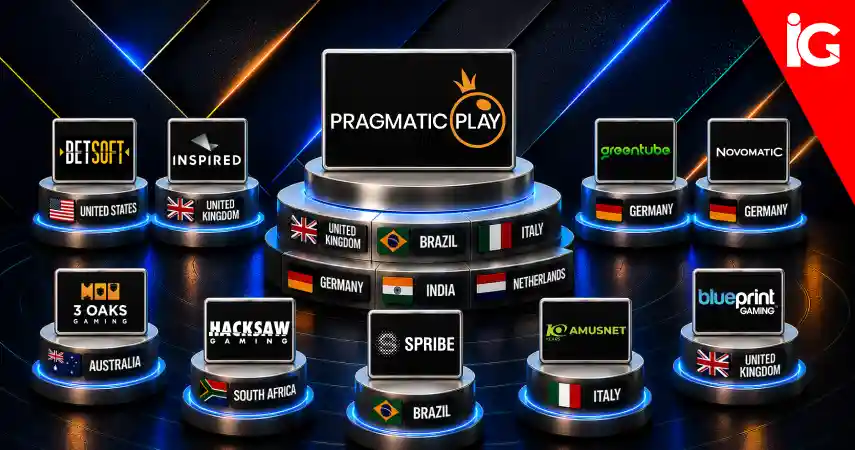
Casino lobbies look infinite. The supply behind them is anything but. Blask measured how many brands carry each game provider across nine markets, and the pattern that emerged says more about regulation than it does about game design.

Pragmatic Play Brand Coverage Across Six Regulated Markets
Pragmatic Play leads brand coverage in six of the nine markets Blask tracked: the UK, Brazil, Italy, India, the Netherlands, and Germany.
The numbers carry the argument. Pragmatic sits on 229 of 295 brands in Brazil, 192 of 249 in Germany, and 173 of 236 in the UK. Roughly three out of every four casino sites. Italy puts the studio on 68 percent of brands, India on 56 percent, and the Netherlands on 56 percent.
That is not market share in the revenue sense. It is shelf space. And shelf space is what determines whether a player ever encounters a game at all.
What Brand Coverage Actually Measures for Casino Operators
The data comes from Game Providers, a Blask feature with a Brand Coverage view. It counts how many brands in a market carry each provider, tracked by lobby presence and updated weekly.
The question it answers is deceptively simple. If you opened every casino in a country, whose games would you see most often?
Three Casino Markets Where the Global Default Fails
Three markets break the pattern, and each breaks it for a reason.
In the US, Betsoft leads with 90 brands and Pragmatic drops to second. The more revealing signal sits lower down the table. Dragon Gaming and RTG rank seventh and eighth, both built for offshore and sweepstakes sites. America’s fragmented, state-by-state regulation grew a separate supply chain, and the global default does not run it.
Australia is still a stranger still. 3 Oaks Gaming leads, BGaming ranks third, and Pragmatic falls to fourth. The country’s offshore, crypto-friendly casino scene favours a different set of studios entirely.
South Africa hands first place to Hacksaw Gaming, a fast-rising modern studio, just ahead of Pragmatic.
Regional Game Providers Holding Local Shelf Space
Even where Pragmatic leads, regional names cluster directly behind it.
Greentube and Novomatic fill Germany’s top six, both Austrian and built for the DACH region. Amusnet ranks third in Italy. Blueprint and Inspired Gaming sit second and fifth in the UK, both rooted in British retail betting.
One name ties supply back to player behaviour. Spribe, maker of the crash hit Aviator, ranks sixth in Brazil. That mirrors exactly where crash games win shelf space.
Why France Has No Casino Provider Ranking
France is missing for a reason. Online casino games are prohibited there. Only betting, horse racing, and poker are legal online. No legal lobby means no provider shelf to count.
Absence is a data point.
Live Casino Distribution and the Evolution Position
Evolution, the live-casino leader with around 2,000 tables, sits in the top four almost everywhere. Pragmatic owns the slots shelf almost everywhere.
“Almost” is the whole story. Wherever a market writes its own rules, through regulation or its absence, the supplier ranking changes with it.

Future Outlook for iGaming Supply Chain Concentration
The direction of travel points one way. As more markets move from grey to regulated, expect the global default to consolidate further in the newly licensed territories, while the offshore supply chain hardens into a genuinely separate ecosystem with its own leaders, its own economics, and its own player expectations.
Hacksaw’s position in South Africa suggests the second pattern worth watching. Modern studios can displace incumbents in markets where distribution is still forming. The window closes as coverage matures.
For operators, the practical question is no longer which studio to sign. It is whether your lobby looks identical to every competitor in your market, and what that costs you.
Blask is an AI-powered platform for iGaming and gambling market analytics, turning fragmented open-source signals into real-time insight on brand visibility, player demand, and baseline revenue metrics.
Source: Blask