



Q1 2026 iGaming Earnings: How the World’s Leading Gaming Companies Performed This Quarter

Three months into 2026, the gambling industry’s biggest operators have reported earnings that look, on the surface, like a story of growth. Nearly all of them expanded. Most set records. Yet beneath the revenue lines, the quarter was far less uniform than the topline figures suggest.
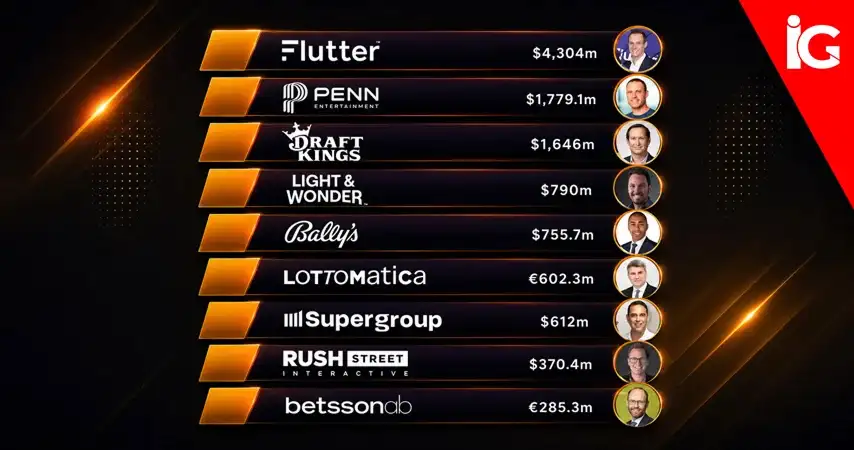
The nine largest listed gaming companies posted a combined sweep of higher revenues for the first quarter of 2026, led by Flutter Entertainment, whose $4.3 billion haul again placed it well ahead of every rival. But growth and profitability moved in opposite directions for several of the field’s most prominent names. Flutter’s revenue rose 17 percent even as its net income fell 38 percent. Bally’s Corporation reported the fastest top-line expansion of any operator and still finished the quarter deep in the red. Rush Street Interactive, long overshadowed by its larger American competitors, grew faster than all of them and remained profitable.
The result is a quarter that resists a single headline. Revenue rank, growth rank, and profit rank now describe three different league tables, and the distance between them is the most revealing figure of all. What follows is how each company performed, in order of revenue.

Flutter Entertainment: $4,304m, up 17%
The owner of FanDuel remains the largest operator in the industry by a wide margin. Under chief executive Peter Jackson, revenue rose 17 percent year on year, lifted by the acquisitions of Snai and Betnacional and a favorable swing in sports results, while group iGaming revenue grew 28 percent.
Profit told a different story. Net income fell 38 percent to $209 million, the result not of weak trading but of the cost of expansion: higher interest and amortization charges tied to the acquisitions, alongside investment in FanDuel Predicts and new state launches in the United States. Flutter’s scale remains its defining advantage. This quarter, it also carried a visible cost.
PENN Entertainment: $1,779.1m, up 6.4%
PENN, led by chief executive Jay Snowden, delivered steady top-line growth, supported by its retail portfolio and a 15 percent rise in standalone iCasino revenue, which reached record quarterly levels. The Interactive division narrowed its losses sharply against the prior year.

The company nonetheless reported a net loss of $2.8 million, a figure distorted by an unusually strong comparison: the first quarter of 2025 had included a one-time financing gain of $215 million. Stripped of that effect, PENN’s underlying recovery is more apparent than the headline loss implies.
DraftKings: $1,646m, up 17%
DraftKings produced one of the cleaner results of the quarter. Revenue rose 17 percent, driven by efficient customer acquisition and an improved sportsbook margin. More significant was the swing to profitability: the company, led by co-founder and chief executive Jason Robins, reported net income of $21.1 million, reversing a prior-year loss, with adjusted earnings rising sharply.
After years of heavy losses, profitability is now visible in the reported figures. Management has signaled that it intends to direct that strength toward prediction markets, an emerging category it expects to lead before year-end.
Light & Wonder: $790m, up 2%
Light & Wonder, under chief executive Matt Wilson, posted a modest revenue increase against a strong prior-year period, with its Gaming operations and iGaming units both delivering double-digit growth. iGaming revenue alone rose 18 percent.
Net income fell 37 percent to $52 million, weighed down by roughly $50 million in legal reserve charges related to legacy litigation. Excluding that charge, the company expanded margins across all three of its business segments, a sign that the underlying performance was stronger than the bottom line suggests.
Bally’s Corporation: $755.7m, up 28.3%
Bally’s Corporation, led by chief executive Robeson Reeves, recorded the fastest reported revenue growth of any company in the field, helped by the Queen acquisition and a 35.9 percent increase in North America Interactive revenue.
The cost of that growth sat below the revenue line. The company carried a net loss in the region of $162 million, driven by refinancing costs and the continued integration of its Intralot business. The reported growth figure also benefits from accounting comparisons; on a like-for-like pro forma basis that includes Queen across both periods, growth was closer to 24 percent. The expansion is real. So is the loss beneath it.
Lottomatica: €602.3m (~$650m), up 3%
Italy’s market leader, led by chairman and chief executive Guglielmo Angelozzi, reported a 3 percent rise in revenue, or 10 percent on a normalized-payout basis. The online segment drove the quarter, growing 10 percent to €264.7 million and lifting the group’s online market share to 31.8 percent.
Net profit reached €69.3 million, with adjusted earnings up 7 percent on a reported basis and 22 percent normalized. It was a profitable, controlled quarter from a company that continues to consolidate its hold on its home market.
Super Group: $612m, up 18%
Super Group, the parent of Betway and Spin, recorded what may have been the quarter’s most understated strong performance. Under chief executive Neal Menashe, revenue rose 18 percent to a record $612 million, profit climbed to $86 million, and adjusted earnings grew 36 percent. Growth was led by its Africa segment, with international markets adding momentum.
There were no one-time charges and no accounting caveats, only disciplined growth and a record 6.4 million monthly active customers. Among the loudest names in the sector, it was one of the cleanest results.
Rush Street Interactive: $370.4m, up 41%
Rush Street, led by chief executive Richard Schwartz, posted the steepest growth rate of any company in the field. Revenue rose 41 percent, net income increased 134 percent to $26.2 million, and monthly active users in its North American online casino markets grew 62 percent year on year.
For an operator long overshadowed by FanDuel and DraftKings, it was a defining quarter. Its casino-first model, concentrated in regulated iGaming states and across Latin America, performed as designed, and the company raised its full-year guidance on the strength of the results.
Betsson: €285.3m, down 3%
Betsson, led by president and chief executive Pontus Lindwall, was the only company in the field to report a decline in revenue, which fell 3 percent, while operating profit dropped 47 percent. The detail beneath those figures complicates the picture: the company’s B2C business grew 15 percent, and on an organic basis the group expanded 4 percent.
The reported decline came almost entirely from a single B2B customer, whose reduced activity cut Betsson’s B2B revenue from €90 million to €51 million. This was not a business losing its core market, but one exposed to the concentration risk that sits inside supplier revenue.
Reading the Quarter
For platform operators, content directors, and anyone planning a partnership for the coming year, the quarter offers a clear read. The largest American operators are spending aggressively, which points to sustained promotional and product intensity through the FIFA World Cup and the next wave of state launches. The mid-tier, led by Rush Street and Super Group, is demonstrating that focused, disciplined models can outgrow the giants without absorbing the same losses. And the supplier side, from Light & Wonder to Betsson’s B2B arm, has shown how a single customer or a single legal matter can reshape a quarter’s results.
Three patterns stand out across the field:
- Scale carries a cost. The biggest operators grew revenue but saw profit fall, as acquisitions, integration, and new-market investment landed before the returns.
- Focus is beating size. Rush Street and Super Group grew faster than the giants while staying clearly profitable, a sign that disciplined models are outperforming sheer scale this cycle.
- Concentration is the hidden risk. Betsson’s decline came from a single B2B customer, a reminder of how exposed supplier and platform revenue can be to one relationship.


What comes next in Q2
The second quarter will test whether the heavily invested operators can convert revenue growth into profit growth, or whether the gap between the two continues to widen. The FIFA World Cup in June is the most obvious catalyst, a tournament expected to lift customer acquisition and handle across nearly every brand in the field. Prediction markets remain the sector’s most-watched wildcard, with DraftKings and Flutter both committing significant investment. New launches, including Alberta in July, will add revenue, though not without cost.
A few things worth watching into the second half of the year:
- The World Cup effect, and which operators turn a spike in handle into lasting customer value rather than one-off activity.
- The profit question, as investors look for the heavy spenders, Flutter chief among them, to show revenue growth translating into stronger margins.
- Prediction markets, where early movers are spending now in the hope of owning a category that barely existed a year ago.
For now, the clearest lesson of the quarter is that the largest revenue did not belong to the strongest business. The companies that recognize that distinction are the ones worth watching into the second half of the year.
Source: Official Company Filings & Earnings Reports