



Crypto Gambling Regulation in 2026: Curaçao vs Anjouan vs Malta

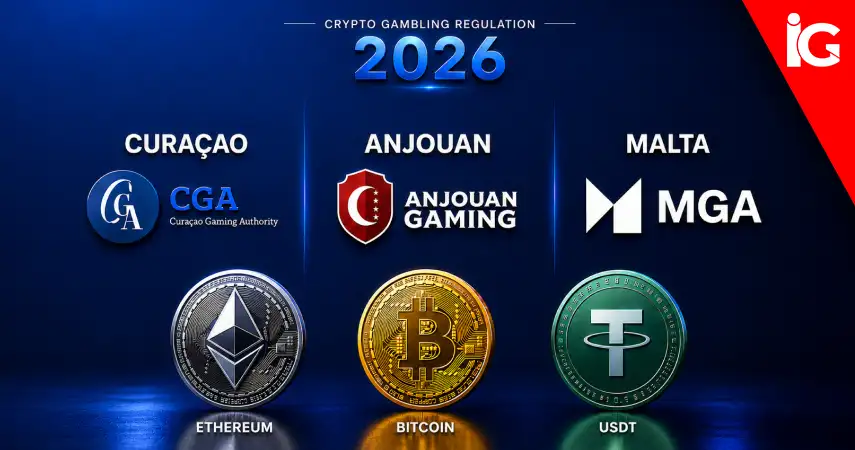
For years, crypto-focused gambling operators clustered in jurisdictions with light-touch oversight. In 2026, that has changed. Offshore regulators are tightening their frameworks, the European Union’s Markets in Crypto-Assets (MiCA) regulation is in force, and international anti-money-laundering standards are being applied more widely. Three jurisdictions illustrate the range of approaches now in play: Curaçao, Anjouan and Malta. Each has chosen a different answer to the same question, and the choice an operator makes today is no longer just about cost.

Curaçao: the LOK reform and the CGA
Curaçao has replaced its long-standing master-licence system. Under the National Ordinance on Games of Chance (the “LOK“), which came into effect on 24 December 2024, the Curaçao Gaming Authority (CGA, formerly the Gaming Control Board) is now the sole body responsible for licensing online gaming. The previous structure, in which a small number of private master-licence holders issued sub-licences, has been phased out.
Key points under the new framework:
- Two licence categories only — B2C (online gaming) and B2B (supplier)
- One regulator — the CGA licenses operators directly and supervises AML and counter-terrorism-financing compliance
- Direct applications — submitted through the CGA’s online portal, which was briefly paused during the LOK transition in late 2024 and reopened in phases through 2025
- Two-phase vetting — integrity and financial standing first, wider regulatory requirements second, each phase targeted at around eight weeks once documentation is complete, with the possibility of extension
- Transition, not a hard cutoff — the last master licences lapsed in early 2025, but sub-licensed operators were not switched off overnight. They moved onto a transitional regime, with provisional LOK licences and extensions running through to 24 December 2025 for operators showing compliance progress
- Appeal route — rejected applicants may file an objection or appeal, generally within six weeks of the decision
What the framework has not yet delivered is a settled track record. The rollout through 2025 was turbulent. The CGA’s supervisory board resigned in September 2025, oversight of the regulator was transferred from the Ministry of Finance to the Ministry of Justice, and the reform became entangled in political controversy surrounding the then-finance minister. The CGA has consistently maintained that licensing and supervision continued without interruption, and some integrity allegations were later retracted. But the episode is a reminder that a framework being legally in force is not the same as it being battle-tested.
Anjouan: flexible, low-cost licensing
Anjouan offers low-cost licensing administered by Anjouan Gaming, the island’s designated internet gaming authority operating under the Anjouan Offshore Finance Authority framework. Licences are issued in two categories, B2C and B2B, and a single B2C licence covers every major vertical, including online casinos, sports betting, poker, prediction markets and crypto-enabled operations, subject to AML and KYC compliance.
The official fee schedule lists €17,828 for licence issuance, €17,828 for annual renewal and €500 per additional domain. These are the licensing fees alone. Operators should budget separately for company incorporation, application processing and compliance setup, which raise the real first-year cost. The bigger draw is fiscal: Anjouan itself levies no tax on gross gaming revenue and no local corporate income tax or VAT on international operations, a sharp contrast to established European regimes, though operators may still face tax obligations in the countries where they are based or operate.

Licensed operators must meet AML obligations, responsible-gaming requirements and ongoing licence conditions. The authority maintains a public register of licensed entities and publishes enforcement actions, and it has suspended at least one licence pending investigation. Compared with established European regimes, oversight is lighter and the process is faster.
Malta: the MGA’s DLT policy and MiCA
Malta regulates crypto in gaming through the Malta Gaming Authority‘s policy on the use of Distributed Ledger Technology. Its requirements are among the strictest in the sector:
- Prior approval required — operators must obtain the MGA’s sign-off before accepting crypto
- Verified wallets only — every wallet must be linked to a verified individual player
- No anonymising coins — virtual assets with built-in anonymisation features are prohibited
- Volatility controls — deposit limits are applied in fiat terms to manage price swings
- Segregated balances — fiat and crypto must be treated separately, and operator platforms cannot function as exchanges
Malta first introduced crypto-asset oversight in gaming through its sandbox framework in 2018 and its Virtual Financial Assets Act the same year. It now operates alongside the EU’s MiCA regulation, which requires crypto-asset service providers serving EU clients to hold the appropriate authorisation. On cost, Malta applies a 5% gaming tax on revenue from players based in Malta, plus compliance contributions and a 35% corporate income tax that is substantially reduced for many operators through Malta’s tax refund system. The fiscal load is heavier than Anjouan’s, but it buys EU access and regulatory standing.
Which jurisdiction fits which operator?
Each framework suits a different type of operator.
Anjouan is best for those prioritising speed and low cost, and willing to accept lighter oversight in exchange. A 0% GGR tax and fast issuance make it the cheapest to run from year one.
Malta is best for those prioritising EU market access and regulatory credibility, accepting a 5% gaming tax, compliance contributions and a longer process in return.
Curaçao sits between the two. Its reformed framework is legally in force and processing applications, but the rollout has been rocky, and it is still early in building the supervisory track record that established regimes can point to.

iGaming News Today — Editorial View
The real story isn’t which jurisdiction offers the best deal. It’s that all three are being pushed in the same direction by the same pressure, and operators who read that signal early may save themselves a costly relicensing exercise later.
Curaçao’s reform shows where this can lead: years of light-touch oversight, followed by a structural overhaul as international scrutiny grew, and a messy, contested transition once the work actually began. Anjouan today occupies much of the space Curaçao held a decade ago, which raises a fair question about whether it could face similar pressure over time.
Our take: if you’re building something meant to last, the licence cost may not be your biggest risk. A jurisdiction’s ability to withstand external regulatory pressure could matter far more. One of these frameworks has already been through that test, painfully and in public. One is still being shaped by it. And one has not yet been tested at all.
Source: CGA, Anjouan Gaming and MGA official sites.