



The Industry Still Calls Them Future Markets. The Timelines Say Otherwise

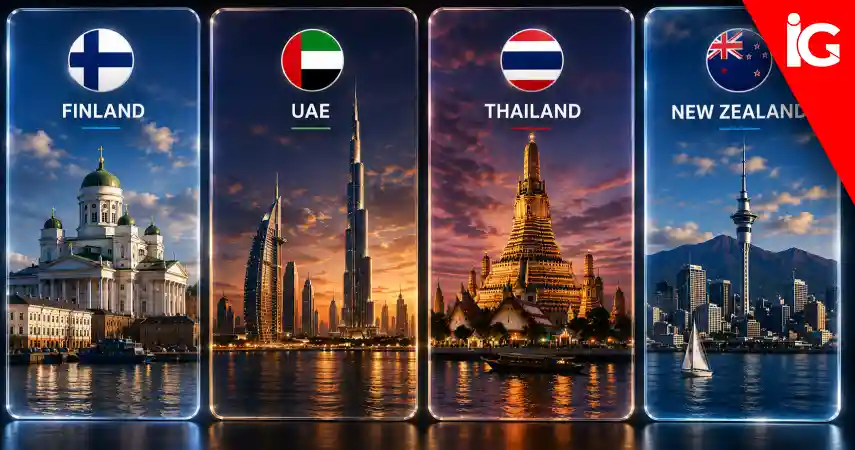
For a year Finland, the UAE, New Zealand and Thailand were grouped as the next markets likely to open. Three of them already have.
There is a habit across this industry of describing regulation in the future tense. A market is “preparing to open.” A government is “moving toward licensing.” The language is comfortable because it leaves room to plan. The problem is that, for three of the four jurisdictions everyone has been watching, it is no longer accurate. Finland, the UAE and New Zealand have passed law and built working frameworks. Thailand has not. The window narrative has quietly become a deadline narrative, and much of the industry’s language has not caught up.

Finland Has Moved Into The Licensing Phase
Start with Finland, because it is the cleanest case. Its Parliament has passed a new Gambling Act, and this is not a draft or a consultation. It is statute. Under the new framework, companies can already apply for gambling licences through the National Police Board, with licensed operations able to begin on 1 July 2027 once the regime enters fully into force.
The reform opens betting, online casino games and certain other online products to competition, while Veikkaus keeps its monopoly on lotteries, scratch cards and physical machines. The detail that should focus operator minds is the queue itself. According to the Borenius briefing, 41 applications had already been filed, and the National Police Board’s target processing time is three to six months. The early movers are not planning their entry. They are already in the system.
The UAE Framework Is Live, Not Forming
The UAE is frequently described as a market that has “established a regulator.” True, but understated. The General Commercial Gaming Regulatory Authority is the federal body responsible for regulating, licensing and supervising commercial gaming, and its remit covers lottery, internet gaming, sports wagering and land-based gaming facilities across all seven emirates.
The legislative spine is in place too. Federal Decree-Law No. 25/2025 provides the foundation empowering the GCGRA to license and supervise all forms of commercial gaming. And the market is past theory. The first licensed online gaming platform in the UAE received its authorisation in late 2025, while Wynn has been licensed to build a physical casino on Al Marjan Island. The country reads less like an emerging opportunity and more like an operating jurisdiction still filling out its licensee list.

New Zealand Has Moved Beyond Consultation
New Zealand is the one that should retire the “introduced legislation” framing entirely. Its Online Casino Gambling Act is now in force, establishing a licensing regime for up to 15 online casino platforms, with harm prevention measures including player-set limits, self-exclusion tools and a ban on credit card payments.
The structure has teeth. Up to 15 licences will be available, each covering one brand, lasting up to three years, with no person holding significant influence over more than three licences, and the competitive process runs through an auction. For operators, that is a hard cap on a finite market. Scarcity changes the maths, because entry strategy, capital and probity documentation all need to exist before the window closes, not after.
Thailand Remains The Outlier
Then there is Thailand, carried along in the same sentence as the other three despite a very different reality. Its Entertainment Complex Bill, the vehicle for legal casinos, has not advanced. The proposal was withdrawn under political pressure and later rejected by a Senate committee over concerns about social impact, infrastructure cost and national security.
There is a revival path, but it is conditional. A coalition agreement reopened the legislative pathway, with partners agreeing to allow up to three entertainment complexes with licensed casino floors, down from the original five, and potential passage by year-end if the calendar allows. Two things matter for an iGaming audience. First, the process remains politically uncertain rather than settled. Second, this bill concerns land-based integrated resorts, not online gaming. Grouping it with three live online frameworks flatters its progress and misreads its scope.
Why The Tense Matters For Operators
Here is the commercial point. The difference between “opening” and “open” is the difference between a planning horizon and a deadline. In Finland, applications are being processed now and competitors are already filed. In New Zealand, a capped pool of licences moves through a competitive auction, which forces decisions into the present quarter. In the UAE, the regulator is issuing licences against a live federal law. None of that rewards a wait-and-see posture.
For a platform head or a market entry lead, the actionable read is to triage. Three of these four jurisdictions belong in the active pipeline, with named processes and finite windows. The fourth, Thailand, belongs in a monitoring column, with a clear caveat about scope and political durability. Treating all four the same way is how a team misses a market that has already opened while it was still being described as prospective.

What Comes Next
The coming months will sharpen all four pictures. Finland’s first licence approvals should test that three-to-six-month processing claim against reality. New Zealand’s auction will reveal who actually paid to enter a capped market, and the bids will price the opportunity better than any forecast. The UAE will keep adding to a licensee roster that is still short. And Thailand’s revived bill will either reach a parliamentary vote or slip back into the instability that has defined it.
The lesson underneath all of this is uncomfortable for anyone still using the old language. Markets rarely announce that they have stopped being prospective. They simply pass a law, open a window, and the operators who were reading the timelines get there first.
Source: Official government and regulatory sources