



Las Vegas, Macau, and Singapore: How Global Casino Giants Are Competing Through Destination Tourism

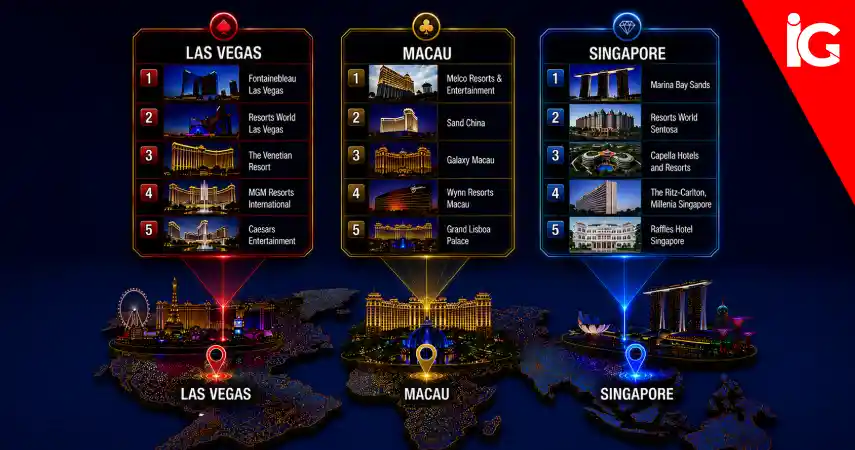
The global casino industry is no longer competing through gaming floors alone. Las Vegas, Macau, and Singapore now represent three competing models of destination tourism, where integrated resorts, luxury hospitality, entertainment, and premium customer experiences increasingly determine market strength.
All three cities remain anchored by casino gaming, but each has built a different strategy for attracting international visitors and extracting value from them. In 2025, those strategies produced very different results, and the gap between them tells the real story.

Las Vegas: The Entertainment-Driven Casino Capital
Las Vegas has positioned itself as an entertainment-first destination where gaming sits alongside conventions, sport, nightlife, premium hospitality, dining, and technology-enabled guest experiences. That diversification was tested in 2025. Visitor numbers fell roughly 7.5 per cent to around 38.5 million, the lowest annual total since 2021, yet Strip gaming revenue held at a record near US$8.8 billion. Fewer people came, and they spent more. The city is quietly pivoting from volume to yield.
Fontainebleau Las Vegas: Reinventing Luxury on the North Strip
Fontainebleau Las Vegas has emerged as one of the Strip’s most ambitious luxury developments, helping reposition the North Strip through premium accommodation, upscale restaurants, nightlife, wellness offerings, and large-scale entertainment programming. The property reflects Las Vegas’s growing emphasis on high-value guest spending beyond the gaming floor.
Resorts World Las Vegas: A Technology-Led Integrated Resort
Resorts World Las Vegas differentiates itself through technology integration and digital-first guest experiences. The property has emphasised cashless gaming, mobile-wallet functionality, digital payments, and frictionless hospitality systems designed to improve convenience while deepening engagement across gaming, hospitality, and entertainment.
The Venetian Resort Las Vegas: Convention Scale Meets Entertainment
The Venetian Resort continues to benefit from its strong convention ecosystem and premium hospitality positioning. Its proximity to Sphere has strengthened its role within the city’s entertainment economy, allowing the resort to capitalise on visitor flows tied to concerts, immersive shows, and corporate travel.
Bellagio Las Vegas: Iconic Premium Hospitality
Bellagio remains one of Las Vegas’s most recognisable luxury casino resorts, combining premium accommodation, fine dining, entertainment, and brand prestige. It continues to attract affluent leisure travellers while reinforcing MGM Resorts International’s premium positioning.
Caesars Palace: Legacy Hospitality and Sportsbook Visibility
Caesars Palace pairs legacy casino appeal with luxury hospitality, entertainment, and sportsbook scale. It remains an important destination for premium gaming customers, large entertainment events, and visitors seeking a recognisable Las Vegas experience.
Las Vegas’s broader strategy increasingly focuses on growing total spend per visitor across multiple channels, reducing reliance on gaming volatility, and monetising tourism through premium experiences. The 2025 numbers suggest that pivot is already underway, by necessity as much as design.
Macau: The Gaming Powerhouse Expanding Beyond Casinos
Macau remains the world’s largest casino market by gaming revenue, supported by dense resort concentration, premium gaming ecosystems, and large-scale integrated developments built to maximise customer spending. The market closed 2025 with gross gaming revenue of MOP247.4 billion, around US$30.8 billion, up 9.1 per cent year on year and its strongest result since 2019, though still below pre-pandemic peaks.
Morpheus at City of Dreams: Architectural Spectacle and Premium Gaming
Morpheus, developed by Melco Resorts & Entertainment, has become one of Macau’s most recognisable luxury casino properties. Known for its futuristic architecture and premium positioning, it combines luxury accommodation, gaming, fine dining, and exclusive hospitality aimed at high-value visitors.
The Londoner Macao: Large-Scale Themed Resort Tourism
The Londoner Macao reflects Sands China’s integrated-resort scale strategy, combining themed architecture, luxury hotels, casino gaming, retail, dining, and entertainment within a single tourism ecosystem. The property reinforces Macau’s reputation for large-format destination resorts.
Galaxy Macau: The Mega-Resort Ecosystem
Galaxy Macau has developed into one of the city’s most expansive hospitality ecosystems, blending gaming operations with luxury hotels, premium retail, leisure attractions, entertainment, and extensive dining designed to extend visitor stays.
Wynn Palace Cotai: Premium Luxury and VIP Focus
Wynn Palace Cotai concentrates on luxury hospitality and premium customer acquisition. Known for high service standards, upscale accommodation, luxury retail, and premium gaming, the property continues to target affluent leisure and VIP customers.
Grand Lisboa Palace: Heritage Meets Luxury Positioning
Grand Lisboa Palace blends European-inspired resort aesthetics with Macau’s gaming heritage, offering luxury accommodation, hospitality, entertainment, and premium gaming aimed at broadening the city’s tourism appeal.
Macau’s long-term challenge lies in balancing gaming dominance with tourism diversification, as operators invest more heavily in non-gaming entertainment, luxury hospitality, and visitor experiences.
Singapore: A Premium Casino Market Built on Scarcity
Singapore has taken a fundamentally different route, prioritising exclusivity, regulation, and premium visitor economics over gaming scale. With only two licensed operators, the market is engineered to maximise value per guest rather than headcount.
Marina Bay Sands: The Global Benchmark for Integrated Resorts
Marina Bay Sands remains one of the world’s most recognisable integrated resorts, combining premium gaming, luxury hospitality, convention facilities, fine dining, entertainment, retail, and skyline attractions into a globally influential destination model.
Resorts World Sentosa: Gaming Combined With Leisure Tourism
Resorts World Sentosa has positioned itself as a broader integrated tourism destination, pairing gaming with hospitality, attractions, leisure experiences, and premium travel offerings that serve both gaming visitors and international tourism segments.
Capella Singapore: Ultra-Premium Exclusivity
Capella Singapore strengthens the city-state’s luxury tourism ecosystem through private, ultra-premium hospitality aimed at executives, affluent travellers, and high-net-worth visitors seeking privacy and exclusivity.
The Ritz-Carlton, Millenia Singapore: Luxury Hospitality for Global Travellers
The Ritz-Carlton, Millenia Singapore reinforces the premium hospitality model through luxury accommodation, skyline positioning, executive travel appeal, and high service standards targeting business and international leisure travellers.
Raffles Hotel Singapore: Heritage Luxury and Prestige
Raffles Hotel Singapore continues to represent timeless prestige within Singapore’s tourism economy. Its historic positioning, luxury reputation, and heritage appeal feed the city-state’s broader premium identity.
Singapore’s competitive advantage increasingly comes from maximising visitor value rather than visitor volume, prioritising premium spending, luxury experiences, and tightly controlled tourism economics.

Three Cities, Three Models, One Competitive Future
Las Vegas, Macau, and Singapore now represent three competing approaches to destination tourism. Las Vegas is leaning into entertainment and diversified spend, a shift sharpened by a year of falling footfall and record gaming revenue. Macau is betting on integrated-resort scale and gaming concentration, backed by its strongest revenue year since the pandemic. Singapore is doubling down on exclusivity, scarcity, and premium visitor economics.
The common thread is uncomfortable for anyone who still measures success by crowd size. Across all three hubs, footfall and profitability are starting to move independently. The next phase of global casino competition will not be decided by which destination fills the most rooms. It will be decided by which one builds the strongest ecosystem for attracting, retaining, and monetising high-value travellers.
Source: Official Government Reports