


How The Tilman Fertitta Empire Grew From Two Diners To A Caesars Deal

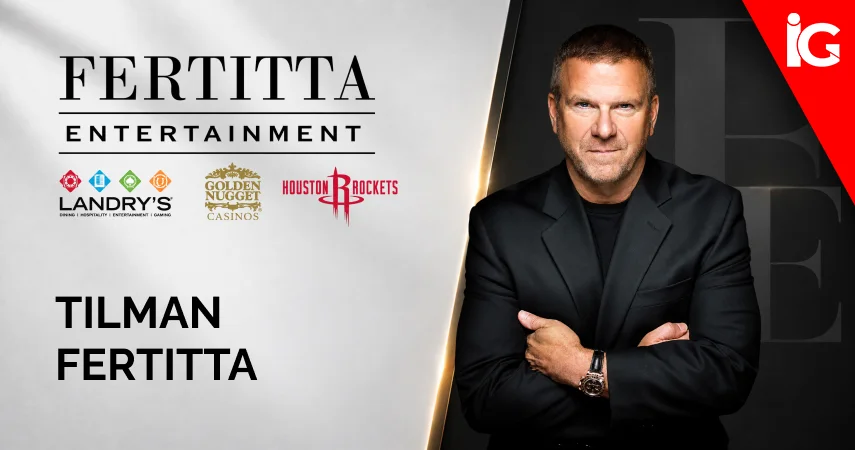
The easiest way to understand the Tilman Fertitta empire is to look at what he owns. The more useful way is to look at what he kept buying next. It begins in 1980, when Fertitta became a partner in the first Landry’s Seafood restaurant in Katy, Texas, followed a year later by the more upscale Willie G’s in Houston. By 1986 he had controlling interest in both. Four decades later, that same operator has entered a definitive agreement to acquire Caesars Entertainment for around $17.6bn. The distance between those two points is the whole story.
The Tilman Fertitta empire started by turning restaurants into destinations
Fertitta never treated Landry’s as a single restaurant brand. He treated it as a platform.

The company expanded concept by concept, but the real shift came when dining stopped being the whole product. In 1998 he opened the Kemah Boardwalk, a 35-acre development combining restaurants, a hotel, rides and a marina. It was not a restaurant with a view. It was a destination, and the restaurant was one reason to visit it.
That instinct, to build the experience around the business rather than sell the business alone, would repeat at every stage that followed.
Gaming connected the empire to a new customer
In 2005 Fertitta acquired the Golden Nugget casinos in Las Vegas and Laughlin for $295m. The portfolio later expanded into markets including Atlantic City, Biloxi and Lake Charles.
The point was never just to own casinos. It was to link them to everything else. Golden Nugget later opened its loyalty programme so members could earn and redeem across Landry’s restaurants nationwide, turning a casino visitor and a diner into the same tracked customer. Gaming and dining stopped being separate businesses and started reinforcing each other.

Online gaming and the Houston Rockets widened the net
The Golden Nugget brand did not stay on the casino floor. Its online arm, Golden Nugget Online Gaming, became a distinct digital business before DraftKings agreed in 2021 to acquire it in a deal valued at around $1.56bn, completing in 2022. It proved the empire’s gaming reach was not tied to physical property.
Then, in 2017, came the move that looked least like the others. Fertitta bought the NBA’s Houston Rockets for $2.2bn. On paper, a basketball team sits far from seafood and slot machines. Strategically it fits perfectly. Sport, like dining and gaming, is a way to own a customer’s leisure time and loyalty. The category changed. The thesis did not.
Caesars is the biggest test of a forty-year idea
Which brings the story to its current chapter. In May 2026, Fertitta Entertainment entered into a definitive agreement to acquire Caesars Entertainment in an all-cash deal valued at around $17.6bn, including roughly $11.9bn of assumed Caesars debt, with shareholders to receive $31.00 per share.
The potential prize is not only the roughly 60 resorts, but linking Caesars Rewards with a network of more than 550 Fertitta dining and hospitality outlets, hotels, and an NBA franchise. If the forty-year plan was to own one customer across every leisure moment, this is the piece that could finally connect them all.
But agreed is not closed. The Caesars deal has board approval and cleared its go-shop period without a rival bid, yet it still needs antitrust and multi-state gaming approvals, and completion is not expected until 2027.
Future Outlook
The next year is about approvals, not announcements. Watch the shareholder vote and the state gaming clearances, and watch how quickly Caesars Rewards gets integrated once, or if, the deal closes, because that is where the strategic value either shows up or fades. For operators and suppliers, the wider signal is clearer than any single milestone. Fertitta did not win by owning the most casinos or the most restaurants. He won by owning the customer across all of it. Caesars is the ultimate version of that bet, and the industry will spend 2027 finding out whether it pays.
Source: Official Company Announcements