



$1B Q1 Revenue. 51.2% Margins. Gaming IP Rising – Hasbro Is Rewriting Its Future Under Chris Cocks

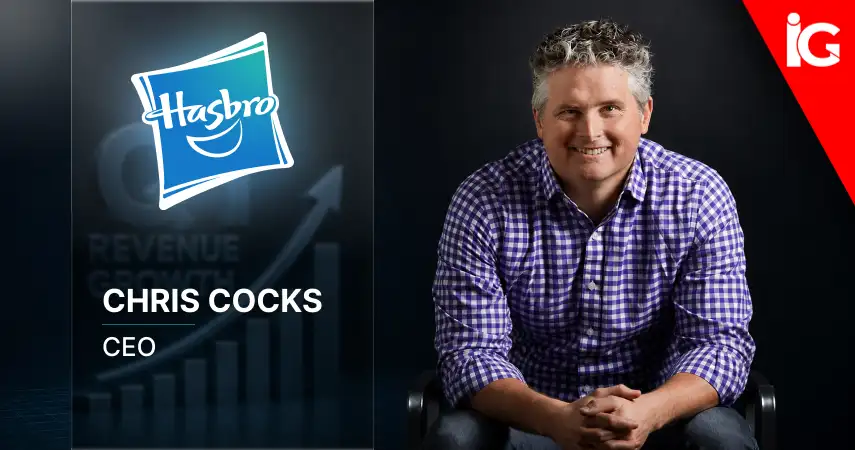
Hasbro reported a stronger first quarter for 2026 as rapid growth in Magic: The Gathering and digital gaming offset softer profitability in parts of its Consumer Products business, reinforcing the company’s increasing reliance on higher-margin gaming intellectual property. Revenue rose 13% year-on-year to $1bn, while operating profit increased 58% to $270.3m. Diluted earnings per share nearly doubled to $1.39 from $0.70 in the prior-year period.
The performance highlighted an increasingly visible shift in Hasbro’s earnings mix. While legacy toy categories continue to represent a substantial share of revenue, profitability is increasingly concentrated within gaming-led brands, particularly collectible franchises and digitally monetised experiences.
Operating margin expanded significantly to 27% from 19.2% a year earlier, while adjusted operating margin improved to 28.7%, reflecting favourable business mix and stronger operating leverage as gaming revenues outpaced lower-margin categories. Net earnings attributable to Hasbro climbed to $198.4m from $98.6m a year earlier, further underscoring the extent of margin expansion across the business.
Chief Executive Chris Cocks attributed the performance to continued execution of Hasbro’s “Playing to Win” strategy, highlighting momentum inside Wizards of the Coast and broader operational discipline across the group. Management maintained its full-year expectations, suggesting confidence that current momentum can continue despite emerging cost pressures.

Wizards of the Coast Continues to Underpin Profitability
The principal growth engine remained Wizards of the Coast and Digital Gaming, where revenue increased 26% year-on-year to $582m, while operating profit reached $297.7m at a 51.2% operating margin. Notably, segment profitability exceeded total group operating profit, illustrating the extent to which gaming economics continue to underpin overall earnings performance.
Magic: The Gathering delivered much of that momentum, with revenue rising 36% to $469.6m. Growth was fuelled by releases including Lorwyn Eclipsed and Teenage Mutant Ninja Turtles Universes Beyond, alongside continued strength from back-catalogue products. Tabletop gaming revenue increased 34%, while digital and licensed gaming delivered comparatively modest growth of 3%.

Mobile title Monopoly Go! also continued contributing meaningfully to results, generating $41m during the quarter and reinforcing the importance of recurring digital monetisation to Hasbro’s gaming portfolio. For investors, the segment increasingly resembles a software-style earnings engine, delivering high margins and scalable monetisation compared with traditional physical toy categories.
Consumer Products Remain Stable but Profitability Faces Headwinds
By contrast, Consumer Products delivered a more mixed performance. Revenue remained effectively flat at $397.9m as gains in key toy and game categories were offset by tougher licensing comparisons from the prior year. Regional performance diverged, with North American sales declining 7%, partially balanced by 17% growth across Europe, while Asia Pacific remained unchanged and Latin America increased modestly.
The division reported an operating loss of $47.5m, reflecting seasonal dynamics, incremental tariff costs and licensing comparisons that weighed on profitability despite stable top-line performance. Hasbro highlighted growth in Star Wars toys and games, with momentum expected to continue ahead of The Mandalorian and Grogu film release.
The quarter nevertheless illustrates a key challenge for Hasbro: while Consumer Products can still maintain scale and market presence, the business remains materially more exposed to tariffs, licensing cycles and regional demand volatility than its gaming-led operations.
Entertainment and Cybersecurity Costs Add Complexity
Entertainment remained comparatively small and volatile within the broader portfolio. Revenue declined 24% to $20.3m due largely to deal timing, although profitability improved as lower royalty costs lifted operating profit to $17.3m. The segment’s earnings profile remains inherently uneven, reflecting the timing-sensitive nature of licensing and production agreements.
At the same time, Hasbro disclosed emerging costs linked to a cybersecurity incident identified in late March. The company said it began incurring legal and remediation expenses during the second quarter after unauthorised network access was detected, although management noted the full financial impact remains uncertain. Hasbro plans to pursue insurance reimbursement for portions of the associated costs, but timing and recovery amounts remain unclear.

Capital Allocation Reflects Confidence in Long-Term Growth
Despite operational headwinds, Hasbro reiterated full-year guidance for revenue growth of 3–5% in constant currency, adjusted operating margin of 24–25% and adjusted EBITDA between $1.4bn and $1.45bn. The decision to maintain guidance signals management confidence that gaming momentum can continue to offset softer dynamics elsewhere in the portfolio.
Capital allocation remained focused on shareholder returns and balance-sheet management. During the quarter, Hasbro returned $106m through dividends and share repurchases while deploying $96m toward debt reduction. The company also issued $400m in new notes to refinance upcoming maturities and repurchase higher-cost debt, reflecting a continued emphasis on financial flexibility.
For industry observers, the quarter reinforces Hasbro’s evolving earnings mix: growth is increasingly tied to collectible gaming franchises and digital monetisation, while Consumer Products remains more exposed to tariff pressures, licensing cycles and regional demand variability. Wizards of the Coast is no longer simply a high-growth segment inside Hasbro – it is increasingly the engine shaping the economics of the wider business.
Source: Hasbro