


Inside Betr: How Joey Levy and Jake Paul Are Building the Next Generation of Sports Betting

Most challenger sportsbooks try to outspend the giants. Betr decided it could not win that fight, so it refused to have it.
When Joey Levy and Jake Paul launched Betr in 2022, the US sports betting market was already crowded with operators burning through hundreds of millions in promotions and customer acquisition. DraftKings, FanDuel, and BetMGM had set the price of entry impossibly high. Two founders with very different backgrounds looked at that climate and made a deliberate choice: they would not compete on budget. They would compete on a product strategy the incumbents had largely ignored: micro-betting integrated with creator-driven media.

Why the Betr Micro-Betting Bet Was Different From the Start
Levy is the co-founder of Simplebet, the B2B technology company that pioneered micro-betting on US sports by building the machine learning and automation infrastructure to make it work at scale. His thesis was simple: legacy sports betting products felt impenetrable to casual fans. Because the global gaming infrastructure was built around soccer-a sport without natural stops-the technology to make in-the-moment wagering intuitive for American sports did not yet exist. So, he built it himself.
Micro-betting turns the precise moments that drive US sports consumption into discrete betting opportunities: the next pitch, the next at-bat, the next play or drive. Levy has frequently pointed to unintuitive user experiences as the only barrier holding back mass adoption.
To prove the built-in demand, he highlighted a telling metric from Simplebet’s historical data: more than a quarter of DraftKings’ in-game gross gaming revenue during Super Bowl LVI came directly from Simplebet’s micro-betting products, despite having no dedicated user experience or targeted marketing behind it. The organic demand was already there. The consumer-facing platform was not.
How the Joey Levy and Jake Paul Partnership Splits the Work
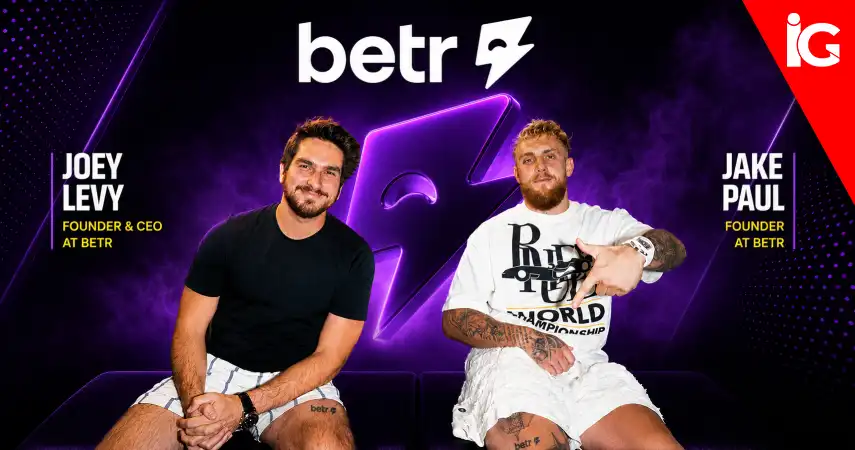
The partnership between a venture-backed tech founder and a professional boxer only looks unlikely on paper. In practice, it represents a clean division of labor. Levy, who serves as chief executive officer, owns the product engineering, gaming licenses, and corporate strategy. Paul, serving as president, owns the distribution. With an audience of over 70 million followers across platforms, he brings the one thing technology startups struggle hardest to manufacture organically: massive consumer attention.

Paul famously described micro-betting as the “TikTok-ification of sports betting,” a framing that is deeply strategic. Rather than treating marketing as a cash-burning line item, the company paired its betting product with Betr Media, an in-house digital network designed to act as a low-cost customer acquisition engine. Neither founder interferes with the other’s domain, which is precisely why the corporate marriage functions.
The Move Toward Vertical Integration and Independence
The capital discipline behind Betr’s early roadmap is what differentiates it from failed direct-to-consumer sportsbooks. The company raised an initial $50 million across its Series A and A1 rounds, backed by institutional funds like Florida Funders, Aliya Capital Partners, and Fuel Venture Capital, alongside notable athletes and team owners.
To maintain low overhead, Betr initially launched its software directly on top of Simplebet’s existing infrastructure. However, as the company matured, Levy realized that relying strictly on third-party frameworks limited product scaling. To achieve true vertical integration, Betr made a major structural move by acquiring the Chameleon Betting Platform from FansUnite for $7.45 million.
This acquisition allowed Betr to shift from a niche micro-betting app to owning its proprietary, full-service V1 Sportsbook engine. This technology allowed them to expand past simple micro-bets into traditional core markets, parlays, and its newly launched Betr Picks and Betr Arcade platforms. Furthermore, when DraftKings acquired Simplebet in late 2024 to take its micro-betting tech in-house, Betr’s foresight in securing its own independent platform tech proved to be a critical defensive and strategic milestone.

What the Betr Strategy Signals for Operators and Founders
There is a distinct lesson here for anyone building in a highly saturated category. Betr did not attempt to invent a new market out of thin air. Instead, it read the consumption habits of the next generation of consumers more accurately than the multi-billion-dollar incumbents did. They built an entire business model around a user behavior that legacy giants had treated as a minor feature rather than a core foundation.
For operators watching the space, the open question remains whether a creator-led, media-first model can scale sustainably against legacy full-service books with infinitely deeper pockets. Micro-betting and live-sports apps also carry inherent product risks, such as streaming latency issues that can leave home viewers a few plays behind the live-money markets.
Ultimately, Betr is a concentrated bet on consumer behavior change. They did not set out to build another standard betting company. They set out to build a highly differentiated digital entertainment ecosystem-and the entire iGaming sector is watching to see if this contrarian playbook wins.
Source: Betr Corporate Information