



10 iGaming Leaders, 1 Question: What Will Define the Future of iGaming?

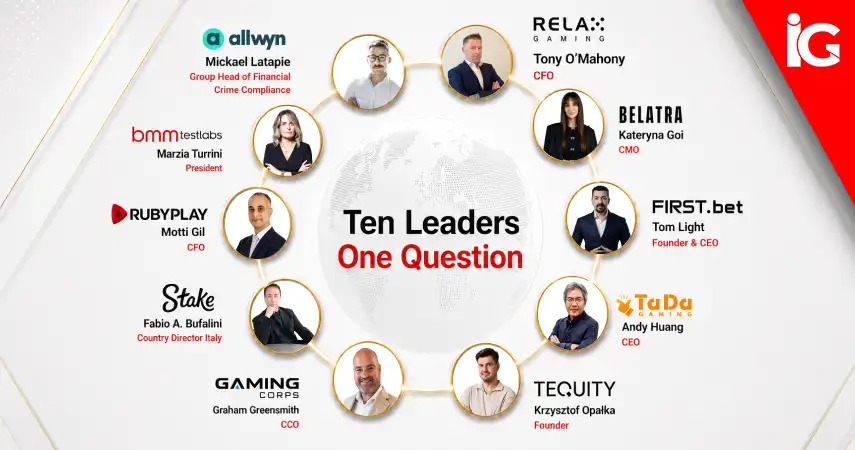
AI, regulation, sports betting, cybersecurity, AML, branding, leadership, sustainable growth – ten leaders, and not one of them named a single force.
The iGaming industry is being pulled in more directions than ever. Technology is changing how products are built. AI is spreading into more of the business. Regulators are redrawing market opportunities. Sports betting keeps evolving. Cybersecurity and financial crime compliance are climbing the strategic agenda.

At the same time, companies are being asked to grow sustainably while building brands strong enough to survive an increasingly crowded market.
So rather than track one trend, iGaming News Today looked across 10 exclusive interviews with industry leaders and asked one bigger question: what will define the future of iGaming?
The answers are different. And that is exactly what makes them interesting.
1. Tony O’Mahony: AI Could Change How iGaming Operates
Relax Gaming’s Chief Product Officer Tony O’Mahony brings the conversation straight to the force reshaping the industry most visibly: artificial intelligence.

His view reflects a wider shift, where AI moves past experimentation and into strategic conversations about efficiency, data and product development. For gaming companies, the question is no longer simply what AI can do. It’s how effectively it gets integrated.
As the tools become more accessible, the competitive difference may come from how companies apply AI rather than whether they use it at all. O’Mahony is clear on one limit, though – human understanding of players and experiences stays essential.
2. Kateryna Goi: When AI Reshapes Branding, Authenticity Matters More
Belatra CMO Kateryna Goi approaches the future from a different angle.
AI gives brands new ways to create and distribute content. But it creates a problem too: when everyone holds similar tools, how does a company stay distinctive? That, she argues, makes brand identity and authenticity more valuable, not less.
Her line lands the point precisely – the brands that stand out won’t be the ones using AI the most. They’ll be the ones using it with the most intention.
3. Tom Light: Sports Betting’s Next Chapter Is Won on Execution
For FIRST.bet Founder and CEO Tom Light, the future of iGaming is tied to the continued evolution of sports betting.
The sportsbook market is increasingly technology-driven, with changing player expectations and fierce competition. Light’s argument is sharp: features like Bet Builder and Cash Out are table stakes now. Everyone can claim them. The real difference is execution – pricing accuracy, speed, and reliability during live events.
The opportunity is significant. So is the pressure to deliver.
4. Andy Huang: Innovation Is Expanding What iGaming Can Become
TaDa Gaming CEO Andy Huang adds another force: innovation, built on discipline rather than noise.
New technologies, formats and player expectations keep expanding what suppliers and operators can build. But Huang’s experience points to a product-led path over M&A, and to a genuine risk in the AI era – a glut of low-quality, mass-produced copycat games flooding the market.
The challenge, then, isn’t innovating more. It’s innovating with purpose.
5. Krzysztof Opałka: AI Is Becoming an Innovation Engine
Tequity Founder Krzysztof Opałka takes the AI thread further, into innovation itself.
AI makes products faster and cheaper to create. But Opałka’s caution is direct: the market is already flooded with content, and assuming ten times more content drives ten times the sales is a mistake. Quality experiences will matter more than volume.
If every company eventually has powerful AI, the advantage shifts to what they choose to do with it.
6. Graham Greensmith: Technology Still Needs Strong Leadership
Not every answer points to a new technology. Gaming Corps Chief Commercial Officer Graham Greensmith brings the conversation back to people.
His principle – “people buy from people” – cuts against the rush to replace the human element with automation. Leaders are being asked to manage growth, uncertainty and increasingly complex regulated markets at once, and that makes adaptability and authentic relationships central.
The strongest technology can’t compensate for weak execution. And the best strategy can’t move without leadership to carry it.
7. Fabio A. Bufalini: Regulated Markets Become a Competitive Advantage
For Stake’s Country Director Italy, Fabio A. Bufalini, the future is tied to succeeding in regulated gaming markets.
He describes Italy as a case study in how much regulation now shapes strategy. By his account it’s the fifth-largest gaming market in the world and second in Europe, with online gaming expected to generate around €6 billion this year – but recent licensing reform cut the market from more than 400 domains to a far smaller, consolidated field, with the licence fee rising sharply. Entering successfully, he argues, demands a completely different mindset: what works globally rarely transfers automatically to a local regulated market.
That makes regulatory knowledge more than a compliance function. It becomes part of the competitive strategy.
8. Motti Gil: Growth Isn’t Enough. It Has to Be Sustainable.
RubyPlay CFO Motti Gil focuses on a defining commercial question: what does sustainable growth actually look like?
His answer is blunt – growth without discipline is expensive. Companies often scale fast and build cost structures that outpace revenue. Gil’s read is that regulated markets, despite thinner margins and higher entry costs, build more durable businesses and usually command higher valuations.
The question shifts from how quickly a company can grow to whether it can keep growing while staying strong enough to adapt.
9. Marzia Turrini: The Future Must Also Be Secure
Technology creates opportunities. It also creates exposure. BMM Testlabs’ Marzia Turrini brings attention to one of the industry’s less visible but rising challenges.
She prefers the term cyber defense over cybersecurity – and calls it a daily necessity rather than a nice-to-have, pointing to regimes like NIS2 in Europe. As gaming businesses become more digital and interconnected, protecting systems, data and players becomes a strategic responsibility, and part of building trust into the infrastructure itself.
An industry that wants to be more technology-driven has to become more resilient too.
10. Mickael Latapie: The Compliance Challenge Is Evolving Too
Allwyn’s Group Head of Financial Crime Compliance, Mickael Latapie, adds a critical final piece, bringing together AML, AI and crypto.
His central point is that financial crime risk in iGaming evolves faster than regulation – new products can emerge with limited oversight, giving criminals an entry point. Crypto exposure is a good example: even operators that don’t offer it directly can be exposed indirectly, because payment providers now integrate crypto wallets. AI can strengthen detection and risk assessment, but Latapie is firm that it augments human judgment rather than replacing it.
The industry is changing. The risks are changing with it.
10 Leaders. 10 Perspectives. One Industry in Transition.
Put these ten perspectives together and a bigger picture forms.
O’Mahony and Opałka point to AI. Goi highlights AI’s effect on branding. Light looks at sports betting execution. Huang focuses on disciplined innovation. Greensmith brings in leadership. Bufalini highlights regulated markets. Gil focuses on sustainable growth. Turrini brings cybersecurity into the conversation. Latapie looks at AML, crypto and evolving compliance.
The answers aren’t identical. No single technology looks capable of defining the whole future. Instead, the interviews point somewhere more complicated: convergence.
AI influences innovation. Innovation changes products. Regulation decides where those products can operate. Cybersecurity decides how much trust sits in the system. AML has to keep pace with new payment methods. Leadership decides how companies respond. And sustainable growth decides whether any of it works over the long term.
So What Actually Defines iGaming’s Future?
The next chapter may not belong to the company with the newest technology or the fastest expansion. It may belong to the companies that can balance several priorities at once – innovating without losing control, growing without sacrificing discipline, using AI without losing the human element, expanding without underestimating regulation, and building digital ecosystems without compromising security.
That’s the common thread running through all ten conversations. The future of iGaming isn’t one story. It’s ten perspectives pointing at the same reality: the industry is becoming more connected, more technology-driven and more complex – and the companies that adapt intelligently may be the ones that shape what comes next.
Ten leaders. One question. A future still being written.
Source: iGaming News Today