



15 Deals Quietly Reshaped Global Gaming – and Most Players Don’t Realize How Big the Shift Became

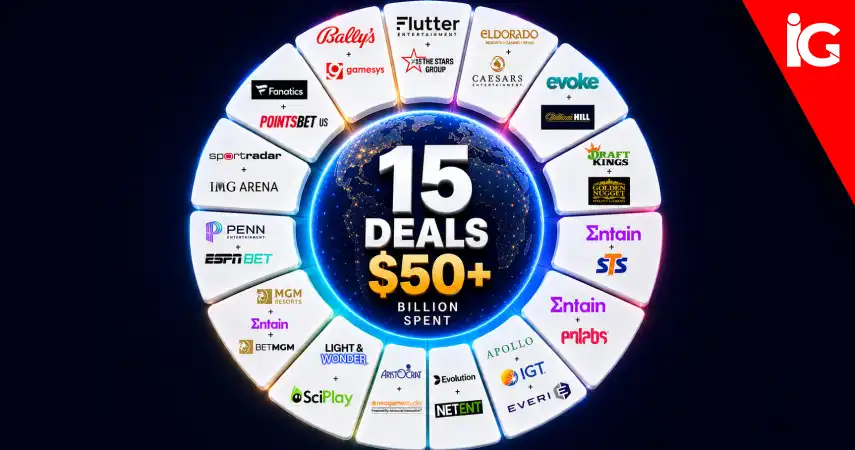
The modern iGaming industry was not built through product innovation alone. Over the past decade, operators, suppliers and gaming technology companies accelerated growth through acquisitions, mergers and infrastructure deals designed to expand market access, improve customer economics and strengthen control across the gaming value chain.
As regulated betting markets matured, scale became increasingly tied to profitability. Rising customer acquisition costs, expensive licensing frameworks, growing compliance obligations and intense competition pushed businesses to pursue consolidation rather than organic expansion alone.
The result has been a structural shift away from standalone betting brands toward vertically integrated gaming ecosystems spanning sportsbook technology, casino content, payments, media partnerships, player databases and betting infrastructure.
Together, these transactions reshaped competitive dynamics across global gaming.

Eldorado Resorts + Caesars Entertainment – $17.3bn
The merger between Eldorado Resorts and Caesars Entertainment created one of the largest gaming operators globally, combining casino assets, sportsbook infrastructure, loyalty systems and player databases under one enterprise.
Beyond scale, the deal strengthened omni-channel economics by linking retail casino operations with digital betting opportunities and larger customer retention ecosystems.
Flutter Entertainment + The Stars Group – $12.3bn
Flutter’s acquisition of The Stars Group materially expanded its global digital footprint by combining sportsbook brands with poker and casino operations.
The deal improved customer lifetime value through stronger cross-sell economics, allowing Flutter to monetise sportsbook users across casino and poker verticals while diversifying revenue exposure.
Apollo Funds acquisition of IGT Gaming and Everi – $6.3bn
Apollo’s acquisition of IGT Gaming and Everi reflected growing investor confidence in gaming infrastructure and enterprise technology.
Rather than focusing on front-end betting brands, the deal consolidated gaming systems, fintech capabilities, casino payments and backend infrastructure into a larger recurring-revenue business.
Bally’s Corporation + Gamesys Group – $2.7bn
Bally’s acquisition of Gamesys accelerated its transition into online gaming by adding iCasino expertise and international digital exposure.
The transaction highlighted how traditional gaming businesses increasingly relied on acquisitions to reduce time-to-market instead of building digital capabilities internally.
Evoke plc (formerly 888 Holdings) + William Hill International – $2.2bn
The acquisition of William Hill International significantly expanded Evoke’s international sportsbook presence and diversified its customer base.
The deal strengthened scale across regulated markets while improving sportsbook distribution and geographic reach.
Evolution + NetEnt – $2.1bn
Evolution’s acquisition of NetEnt reshaped supplier economics by combining live casino leadership with premium slot content.
The transaction strengthened supplier leverage, allowing Evolution to bundle live dealer products with high-performing RNG content and deepen operator dependency on integrated gaming portfolios.
DraftKings + Golden Nugget Online Gaming – $1.56bn
DraftKings acquired Golden Nugget Online Gaming to deepen exposure to online casino revenue, a segment generally viewed as higher margin than sportsbook operations.
The deal reinforced a broader industry reality: sportsbook customer acquisition alone often struggles to generate sustainable profitability without casino cross-sell and higher wallet share.
Light & Wonder + SciPlay – $1.5bn
Light & Wonder’s acquisition of remaining public shares in SciPlay increased ownership across mobile and digital gaming assets.
The move strengthened integration between land-based gaming, social gaming and digital engagement – expanding long-term customer monetisation opportunities.
Entain + STS Holding – $946m
Entain’s acquisition of Poland-based STS strengthened exposure to one of Europe’s largest regulated betting markets.
Rather than pursuing transformational M&A, Entain used targeted acquisitions to improve regulated revenue mix and regional market access.
Aristocrat + NeoGames – $1.2bn
Aristocrat expanded into iLottery and gaming technology through its acquisition of NeoGames.
The transaction demonstrated how gaming suppliers increasingly sought platform ownership and regulated digital infrastructure instead of remaining solely content providers.
Fanatics acquisition of PointsBet US assets – $225m
Fanatics used PointsBet’s US assets as a shortcut into regulated sports betting markets, accelerating licensing, operations and customer acquisition.
The deal illustrated how acquisitions increasingly functioned as market-entry tools in jurisdictions where scale and speed matter.
Caesars Entertainment + William Hill – $3.7bn
Caesars’ acquisition of William Hill strengthened sportsbook capabilities at a pivotal moment in US sports betting expansion.
The transaction provided operational expertise, trading technology and brand infrastructure as operators raced to capitalise on post-PASPA growth.
PENN Entertainment + Barstool Sports – $551m
PENN’s Barstool acquisition highlighted the growing role of audience ownership and media-driven acquisition strategies in sportsbook economics.
Although later replaced by ESPN Bet, the transaction demonstrated how operators increasingly pursued media ecosystems to lower acquisition costs.
Sportradar acquisition of IMG Arena betting-rights portfolio
Sportradar’s acquisition of IMG Arena’s betting-rights portfolio strengthened control over sports data, streaming rights and betting-related media assets.
The move reinforced an important competitive shift: exclusive access to data and live content increasingly influences sportsbook differentiation.
BetMGM (MGM Resorts International + Entain)
BetMGM remains one of the strongest examples of partnership-led market expansion in regulated gaming.
By combining MGM’s land-based casino presence with Entain’s sportsbook technology, the venture demonstrated how strategic partnerships can replicate acquisition-like scale advantages.

The Bigger Industry Shift: From Brands to Ecosystems
The biggest lesson from gaming consolidation was not simply scale – it was control.
Leading gaming businesses increasingly pursued ownership across sportsbook technology, casino content, payments, player databases, media rights, live data and geographic market access to reduce third-party dependency and improve long-term operating leverage.
In modern iGaming, competitive advantage is increasingly defined by ecosystem ownership rather than standalone betting brands. Companies no longer compete only on odds, promotions or market share. They compete on infrastructure, customer retention, distribution and the ability to control more of the economics across the gaming journey.
The industry’s biggest acquisitions reshaped not only company size, but how gaming businesses fundamentally operate.
Source: Official Company Reports