


Gambling Regulation Weekly Roundup: Penalties and Sanctions, EU Anti-Money Laundering Rules and Governance Moves

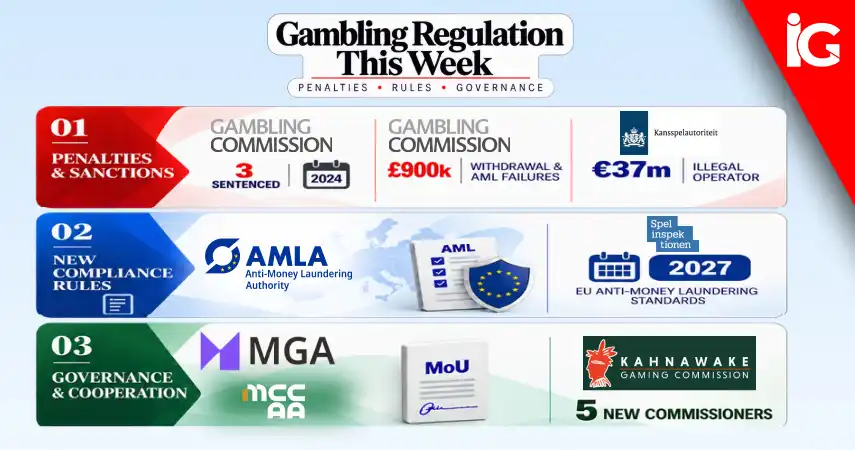
Six regulatory moves landed across five jurisdictions in a single week. They are easier to read grouped by type than by country.
They split cleanly into three categories: penalties and sanctions, new compliance rules, and governance and cooperation. Sorted this way, the week stops looking like six unrelated notices and starts looking like a pattern. Penalties, rule-making and institutional governance are all firming up at once, which is the part operators planning for 2027 will want to weigh.

Penalties and sanctions: UK Gambling Commission secures first election betting sentences
The UK Gambling Commission secured sentences against three people for cheating relating to bets placed on the date of the 2024 General Election. Anthony Lee, Laura Lee and Amy Hind appeared at Southwark Crown Court on 23 October 2026, having previously pleaded guilty to offences under section 42 of the Gambling Act 2005.
The sentences were:
- Anthony Lee: 10 months and 2 weeks on each count, served concurrently and suspended for 12 months, with 100 hours of unpaid work
- Laura Lee: 4 months and 2 weeks, suspended for 12 months, with 40 hours of unpaid work
- Amy Hind: 6 months, suspended for 12 months, with 50 hours of unpaid work
All three face a 12-month probation requirement and a 12-month ban on using online gambling applications. Anthony Lee and Laura Lee are each to pay £1,000 in prosecution costs, with no order for costs made in respect of Amy Hind.
The court heard the election date was announced by then Prime Minister Rishi Sunak on 22 May 2024, and that operators had offered markets on the timing. Anthony Lee, then the Conservative Party’s Director of Campaigning, was party to confidential discussions about the date and used that information to bet, passing it to his wife Laura Lee, who was Head of International for the party and a candidate at the election. Amy Hind, who had previously worked for the party and was then working for the NHS, placed bets after receiving confidential information.

The Commission set out why the case mattered to market integrity:
“Betting markets must be fair and must not be undermined by people using confidential information for their own benefit.”
Katharine Diamond, General Counsel, UK Gambling Commission
The Commission has previously announced that Craig Williams pleaded guilty to a related offence and will be sentenced later. A further ten individuals, named by the Commission, are charged with offences relating to bets on the election date and are due to stand trial in September 2027 and January 2028.
Penalties and sanctions: L & L Europe fined £900,000 over withdrawal and AML failures
The UK Gambling Commission also confirmed that L & L Europe Limited is to pay £900,000 as part of a regulatory settlement. The operator runs seven websites, including allbritishcasino.com, casinocasino.com and hypercasino.com.
The Commission’s findings covered three areas:
- Withdrawals: a term and condition permitting only one withdrawal request at a time, deemed unfair under the Consumer Rights Act 2015, and manual reviews of every fifth or tenth withdrawal for some customers that required additional information at the wrong stage
- Anti-money laundering: controls based largely on financial thresholds and sampling rather than customer risk profiles
- Social responsibility: safer gambling alerts that were not applied consistently across the operator’s full suite of websites
The regulator framed the case around a basic consumer expectation:
“A basic expectation is that when you have winnings you can withdraw those swiftly without hinderance from unfair terms and conditions or the operator failing to carry out checks at an earlier stage. That is essential to consumer trust.”
Sue Young, Executive Director of Operations, UK Gambling Commission
Penalties and sanctions: Kansspelautoriteit issues its highest fine for an illegal offering to EOD Code
The third penalty came from the Netherlands. The Kansspelautoriteit (Ksa) fined EOD Code SRL for offering illegal gambling without a licence on multiple websites, including Instantcasino and Skyhills.
According to the regulator, its employees were able to gamble on several of the company’s sites without measures to prevent participation from the Netherlands, and further investigation uncovered additional sites involved in the illegal offering.
The Ksa pointed to aggravating circumstances including a lack of visible age verification and the option to pay with cryptocurrency and anonymous payment methods, which it said facilitates money laundering. Because it estimated higher earnings from Dutch players, it chose a revenue-based fine of €37 million, which it states is the highest it has imposed for an illegal offering to date.
New compliance rules: EU AMLA finalises three anti-money laundering standards ahead of July 2027
Away from penalties, the week’s most forward-reaching move was rule-making. The EU’s anti-money laundering authority AMLA completed three regulatory technical standards that complement the new Anti-Money Laundering Regulation, which applies from 10 July 2027. That date gives the European industry a fixed deadline to build toward, which is what gives this item its weight.
As reported by Sweden’s Spelinspektionen, the standards cover:
- Customer due diligence: the information companies must obtain and verify, including simplified measures for low-risk situations and identity verification through electronic identification
- Individual transactions: thresholds for individual transactions and how these are distinguished from business relationships, with sectoral criteria
- Group-wide requirements: minimum requirements for group-wide policies, procedures and controls, including additional measures where branches and subsidiaries sit in third countries
The standards will now be approved by the European Commission.
Governance and cooperation: Malta Gaming Authority signs player-protection MoU with the MCCAA
The Malta Gaming Authority (MGA) and the Malta Competition and Consumer Affairs Authority (MCCAA) signed a Memorandum of Understanding to strengthen cooperation on consumer affairs and player protection within the gaming sector.
The agreement establishes a formal framework for collaboration, communication and the exchange of relevant information, intended to ensure consumers are directed to the appropriate authority and receive the necessary support.
The MGA framed the agreement as a way to close gaps between the two authorities:
“Effective player protection requires more than strong regulatory frameworks. It also depends on authorities working together, sharing expertise and ensuring that consumers do not fall through the gaps between their respective remits. This agreement strengthens our ability to do just that, reinforcing our commitment to a regulatory environment where player interests remain firmly at the forefront.”
Charles Mizzi, Chief Executive Officer, Malta Gaming Authority
MCCAA Executive Chairperson Carmen Ciantar said the agreement formalises an already constructive relationship and provides a clear framework for addressing consumer concerns in the sector efficiently.
Governance and cooperation: Kahnawà:ke Gaming Commission appoints five new Commissioners
The second governance move came from Canada. The Kahnawà:ke Gaming Commission announced the appointments of Peggy Mayo Standup, Marcy Delisle, Michelle Phillips, Daryl Leclaire and Frank McComber as Commissioners, made by the Mohawk Council of Kahnawà:ke on 13 October 2026.
The appointments fill vacancies created by the resignations of Heather Bauersfeld and Donna McComber. The new Commissioners join previously appointed Commissioners Vicky Diabo and Janice Beauvais. The Commission, established in 1996, has licensed and regulated online and land-based gaming within Kahnawà:ke since that time.
Which category of regulation will demand the most from operators in 2027?
Grouped by type, the week makes its own argument. Penalties are the loudest category, with three separate fines and sentences. But the AMLA standards may carry the longest tail, since they give the EU industry a firm 10 July 2027 compliance date to build toward.
The governance moves in Malta and Kahnawà:ke are quieter, yet they signal that regulators are also strengthening the institutions behind the rules. For operators running across multiple markets, the lesson is that pressure is arriving on three fronts at once, and a roadmap built around only one of them is likely to leave gaps.
Source: Official regulator announcements